Composite worlds
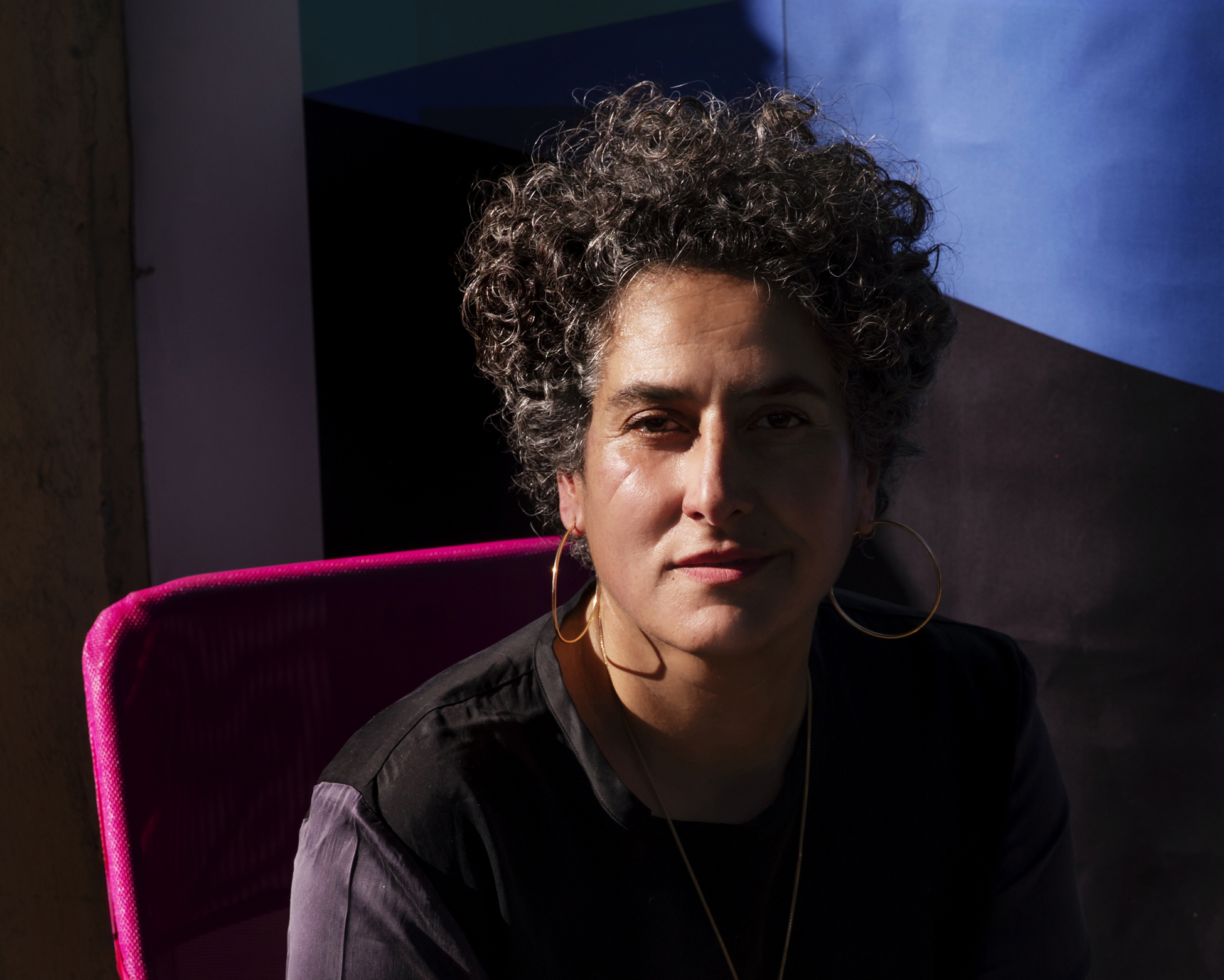 Portrait of Shirana Shahbazi, photo: Anne Morgenstern
Few artists working with photography today are as versatile as Shirana Shahbazi. Since the turn of the millennium, she has constantly experimented with and expanded the potential of her medium, combining its ability to capture the world with ventures into abstraction, architecture and, most recently, film. This summer, a show at Kunstmuseum Luzern and a large-scale public art project in Zurich offer the chance to delve into Shahbazi’s stunningly beautiful yet conceptually rigorous body of work.
Right now, if you look up at the towers of the Grossmünster – a Romanesque landmark church in the heart of Zurich that dates back almost a millennium – you will see images of people who seem to be floating weightlessly in thin air. Along with numerous other motifs – historical figures, architectural details and fragments from books, clouds, cats, even a disco ball – these floating bodies are part of ‘Tut um Gottes Willen etwas Tapferes’ (For God’s Sake, Do Something Brave), a public art project by Shirana Shahbazi installed on the building’s scaffolding whilst it undergoes renovation. The artist made it look as if her models were suspended in mid-air by photographing them floating underwater. Yet on a sky-high church tower these figures could also be viewed as bodies tumbling from the heavens after they have been expelled: abandoned, alone and relying on nothing but their faith.
Falling bodies are certainly a recurring motif in Shahbazi’s recent work. They also feature in a 2023 series simply titled ‘Falling’, which combines a realistic motif with various abstract geometric colour fields. In ‘Falling_01’, for example, a work held by the Julius Baer Art Collection, we see a fully clothed woman floating underwater, rendered in sharp black and white. Jagged gradient shapes in yellowish reds and magenta overlay the image. This artificial yet sensual layer of colour functions like a translucent curtain by pushing the image of the falling body further back within the composition, introducing a clear distance to the realistically depicted motif and bringing out the flatness of the pictorial plane instead.
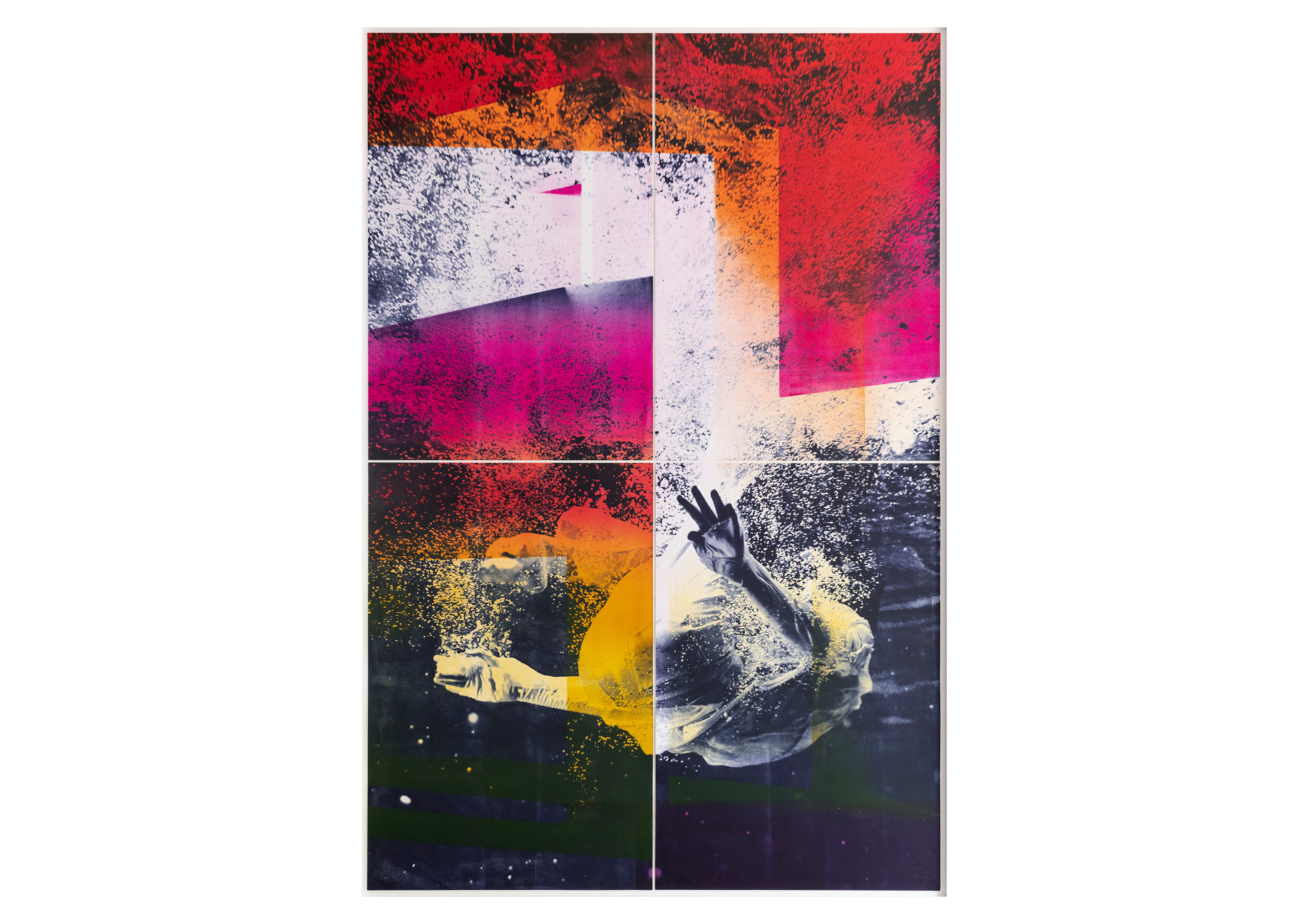 Shirana Shahbazi (b. 1974), ‘Falling_01’, 2023, lithography on cotton paper, 247.5 x 167.5 cm, courtesy the artist and Julius Baer Art Collection
THE POTENTIALS AND PITFALLS OF PHOTOGRAPHY
Shahbazi frequently adopts this two-fold approach, playfully engaging with striking colours and abstract
composition while also using it to question the rhetorical power of photography that stems from its
ability to record reality in a seemingly ‘objective’ manner. As an artist, she has a clear understanding
of her medium’s potentials and pitfalls. ‘Having been raised in a heavily politicised private and social
context, I first wanted to become a photo journalist,’ the artist once said in an interview. Born in
Tehran, Iran, Shahbazi moved to Germany with her parents at a young age, then initially studied in
Dortmund before moving on to the Hochschule für Gestaltung und Kunst in Zurich. ‘But the emigration to
Germany and the intellectual grappling with the medium of photography, later on in my studies, helped to
familiarise myself with photography’s contradictory relationship to outside reality. A clear sense of
belonging gradually dissolved and I became aware of the importance of perspective and language, along
with the challenges of translation and of the transcultural construction of meaning.’
Needless to say, this ‘contradictory relationship to outside reality’ has become even more ambiguous as photography has shifted to digital technologies since the turn of the millennium. Digitisation has had a two-edged effect on photography: on the one hand it further undercut the belief in the medium’s seemingly privileged relationship with reality, thereby quite literally lifting the weight of the world from its shoulders, yet at the same time it robbed photography of the specific surplus generated by its supposed ‘truthfulness’. Shahbazi still works with analogue technology, mainly because, as she stated in the interview, the slow processes give her ‘time to think and space to experiment’, and in fact she hardly ever directly addresses issues pertaining to digitisation in her work. However, as a general historical condition, the shift to digital photography inevitably forms the backdrop to her practice. Indeed, it might be tempting to read the motif of the falling body – that striking visualisation of groundlessness, freedom and self-reliance – not only as a poetic comment on the human condition but also as a metaphor for the highly ambiguous state of photography in the age of digitisation.
A MULTIFACETED APPROACH FOR A FRAGMENTED WORLD
In a stunning body of work she has been developing since around the turn of the millennium, Shahbazi has
perfected a multifarious, consciously fragmented methodology that is as critically aware as it takes
visible pleasure in composing with form and colour. Her achievement was recognised in 2019 when she was
awarded Switzerland’s most prestigious art prize, the Prix Meret Oppenheim.
Over the years, she seems to have broken up any unified – and unifying – vision of the world into fractals, in a manner akin to a prism. In presenting various uses of photography side by side, she almost seems to be providing an overview of potential approaches to making images with the medium. Taken as a whole, however, they seem to supplement each other, amalgamating into a mosaic of shards, snippets, parallel threads and specific perspectives. And collectively they comprise a mode of image-making that may very well be suited to an increasingly fragmented reality.
To grasp their scope, just take a look at the thirteen works by Shahbazi from the last two decades that are currently part of the Julius Baer Art Collection. There is the classical still-life photography of ‘Vogel-03’ from 2007, and the combination of a crisply photographed, almost hyper-realistic apple – complete with lush green leaves, as if freshly picked from the tree – with a bright monochromatic background in the 2009 work ‘Frucht-07’. ‘Komposition-48’ from 2012 is an utterly abstract and almost fractal colour composition that adds a truly anti-representational twist to a medium more generally understood as being thoroughly representational. Then there are the works almost resembling street photography or snapshots (like ‘Pool’, ‘Mickey’ and ‘Gasstation’, all 2014), which have been printed on delicate handmade paper to give them a particular depth and haptic touch. Meanwhile, a piece like ‘Luftpflanze blau (dunkelblau)’ from 2020 uses a bulky and brightly coloured glazed ceramic frame to turn a free-floating depiction of a soilless plant into a deliberately hefty object, thus effectively confining and anchoring the image (and possibly acting as yet another metaphor for photography’s contemporary ‘uprootedness’ – as well as a potentially ‘grounding’ counter-strategy?).
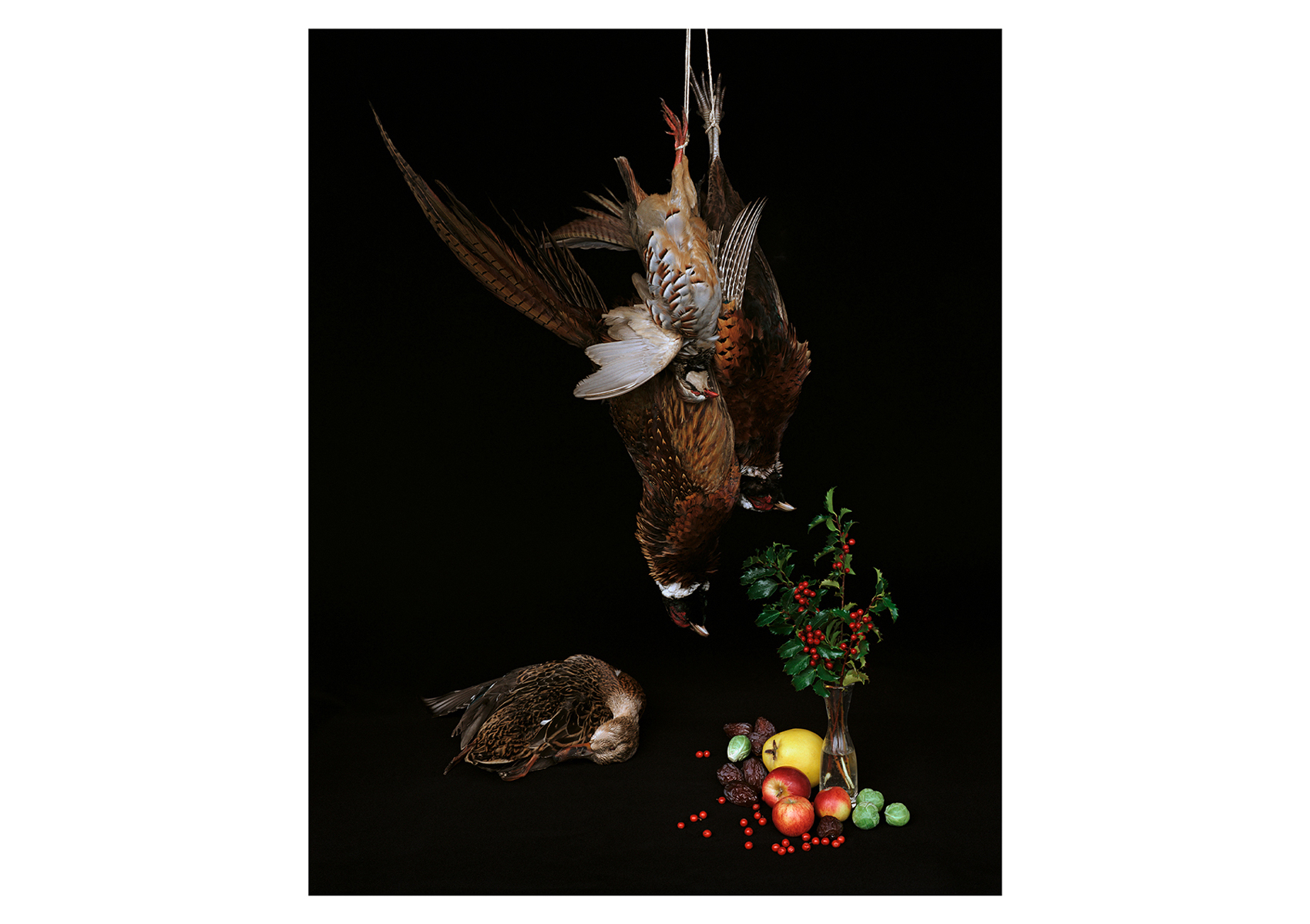
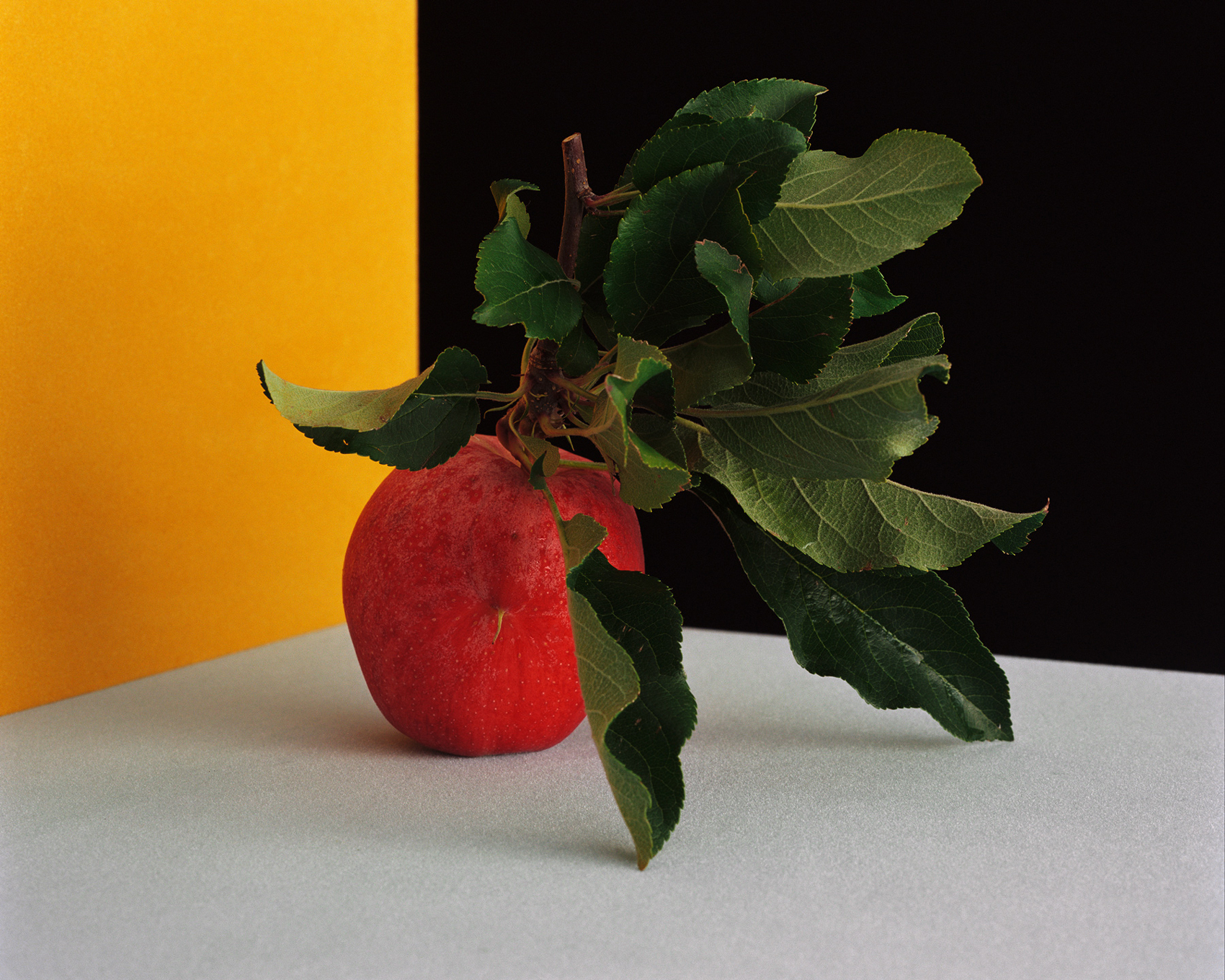
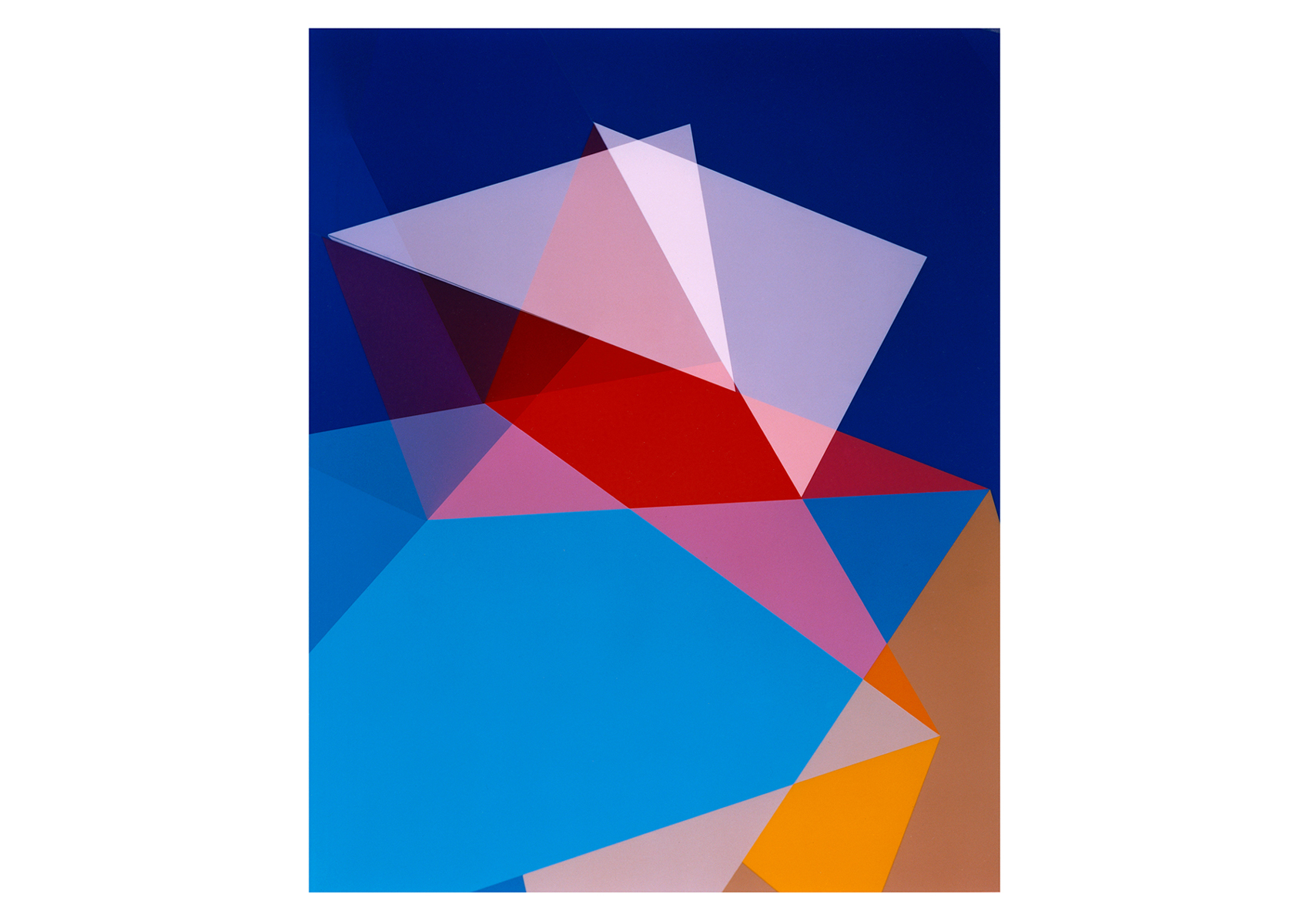
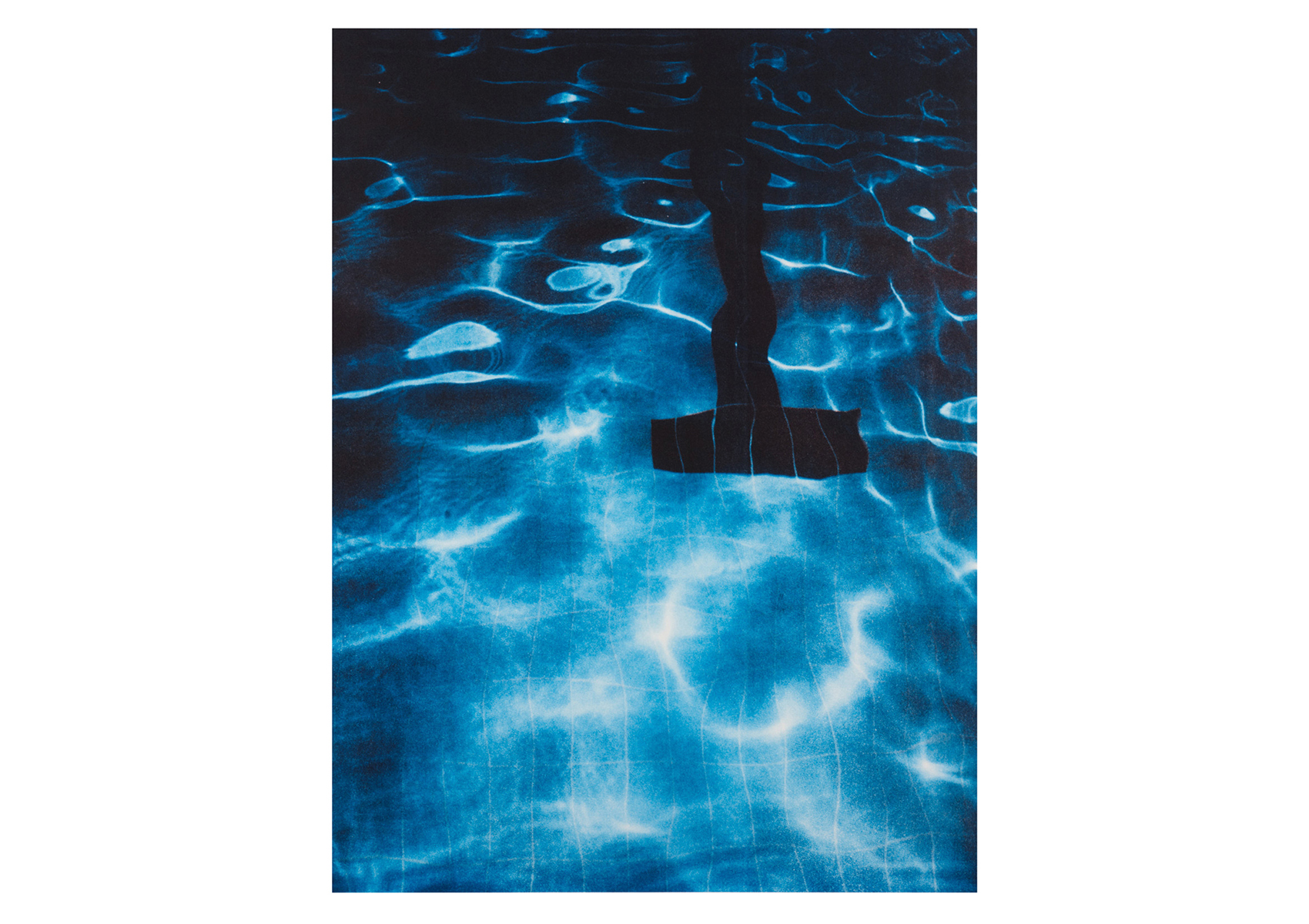
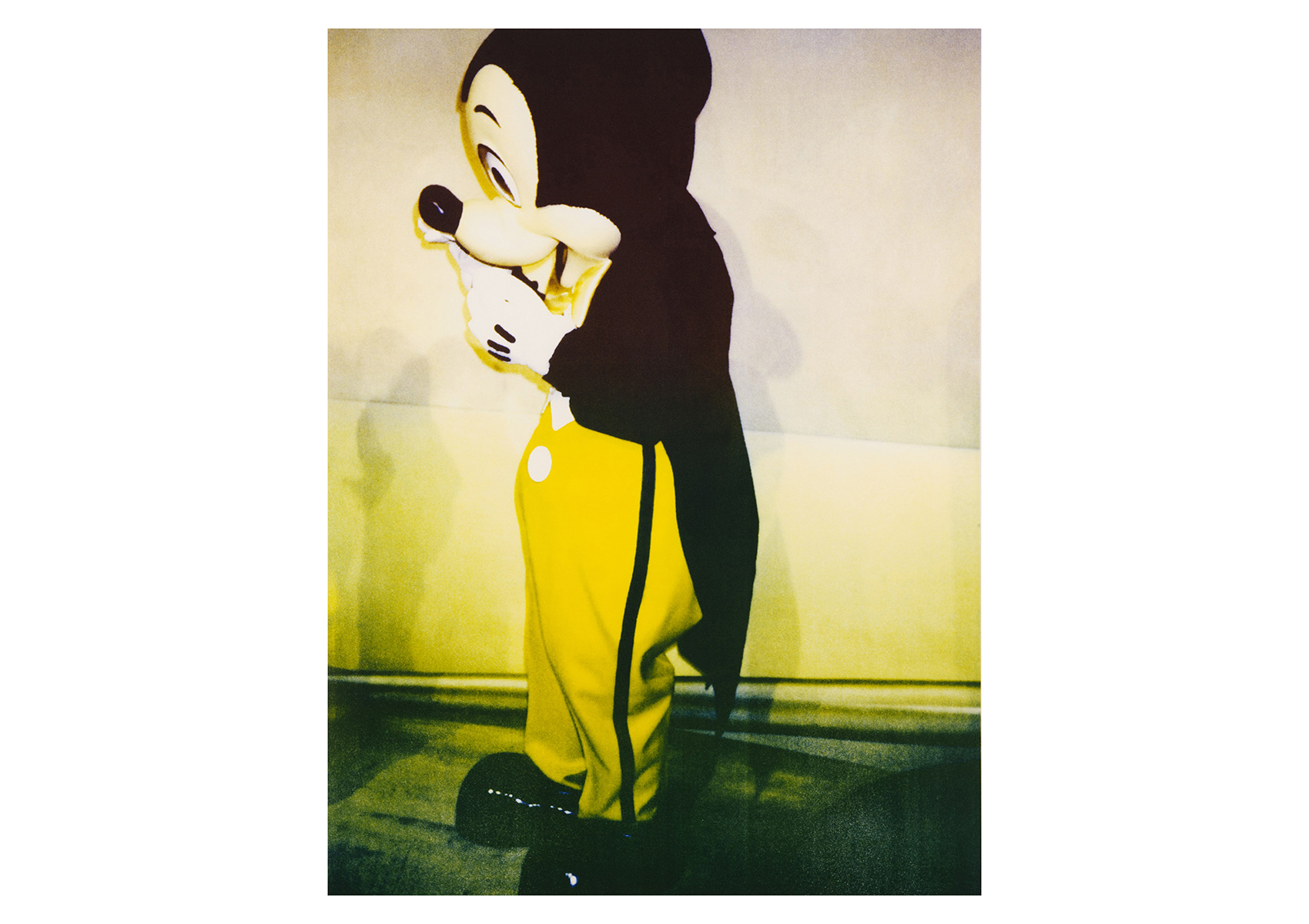
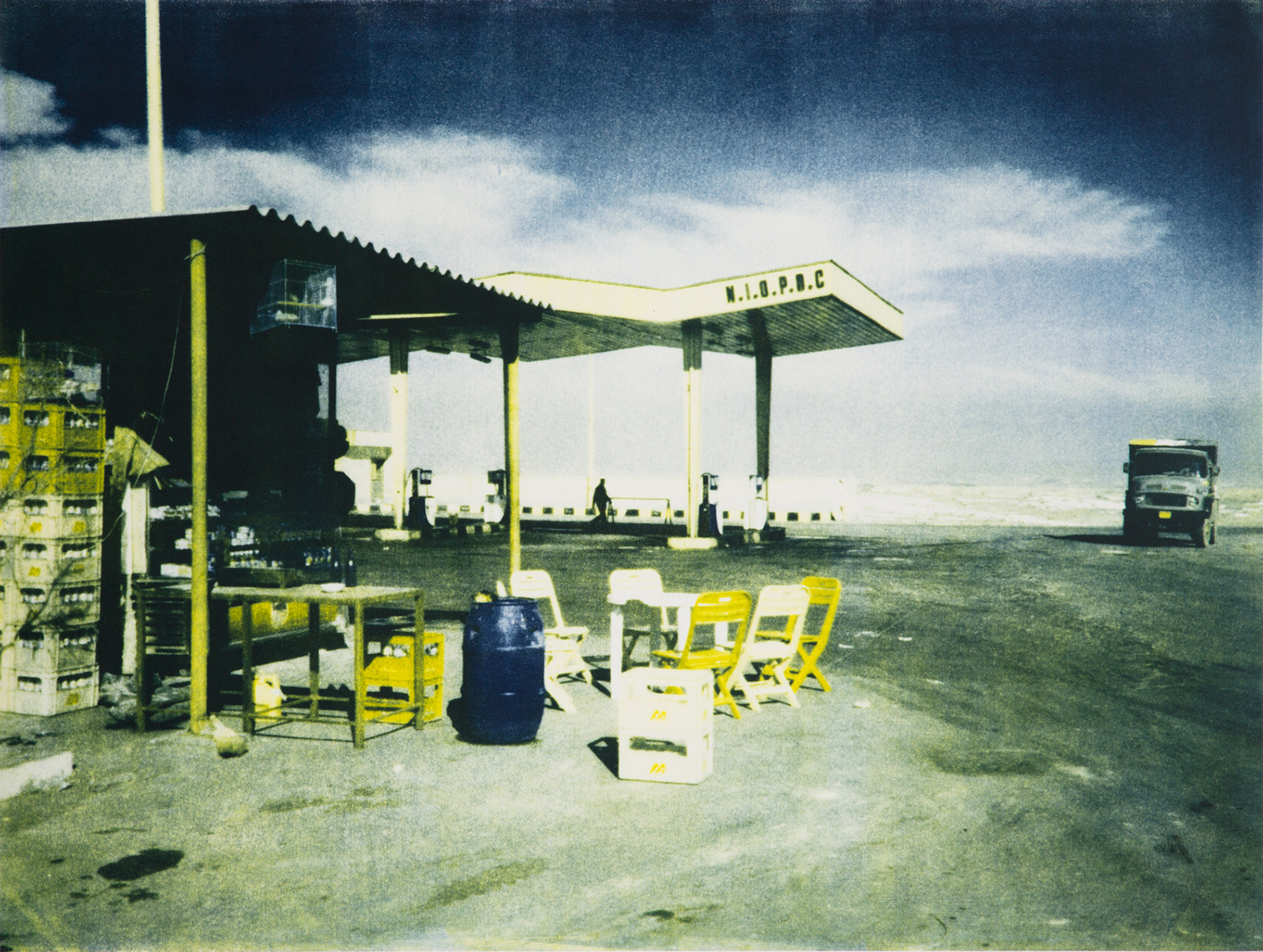
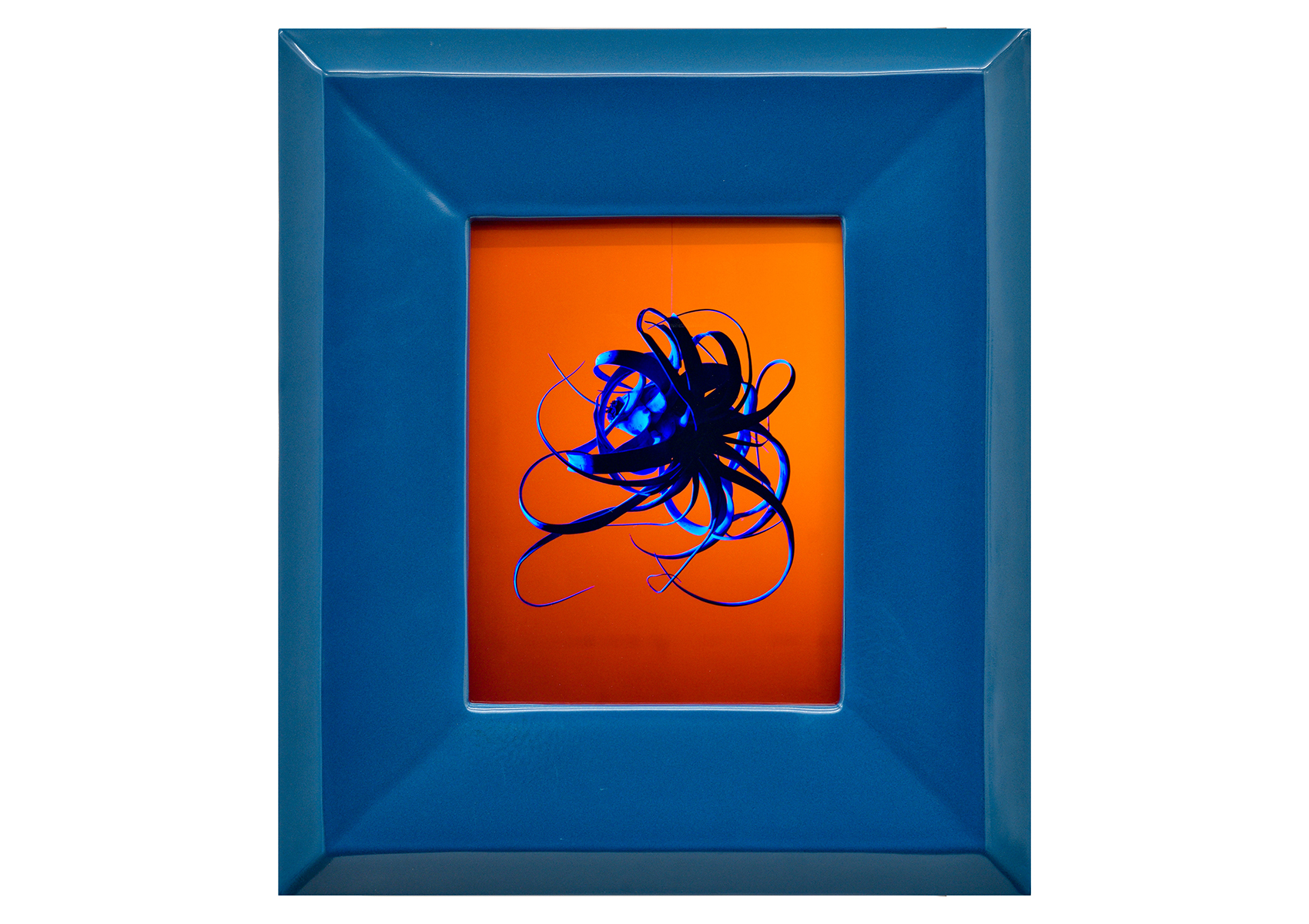
44 x 38 cm, courtesy the artist and Julius Baer Art Collection
In many of her recent works, Shahbazi intricately layers representational photographs with abstract and glaringly bright colour fields. The ‘Falling’ series mentioned above and the 2020 work ‘Cadillac and Kiosk’, to pick another conspicuous example from the collection, both highlight the artist’s combinatory and compositional approach in this respect. In the latter case, the artist gives an ironic nod to photography’s own history by reappropriating one of her earlier pictures – an old, defunct car reminiscent of those prototypical American 1970s or 80s street cruisers so often featured in classical street photography – and recombines it with another image showing a rusty metal fence, then superimposes bright colours onto the larger section of the picture. The result is a composition that blends photography’s broader history with her own existing work and combines realistic ‘figurative’ depiction with sheer abstract colour. Ultimately, Shahbazi arrives at a beautiful, sensual piece of art that feels closer to painting than to conventional photography.
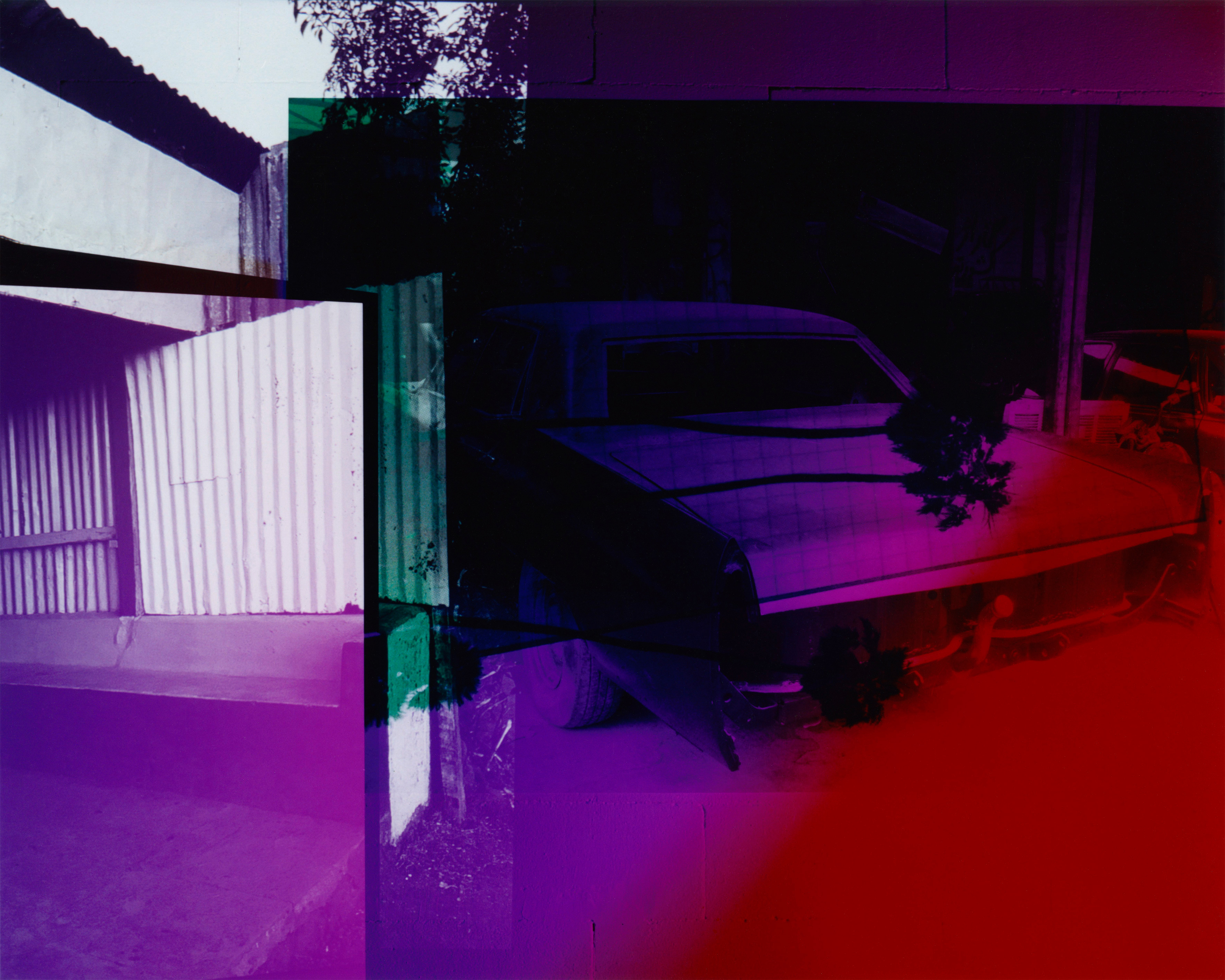 Shirana Shahbazi (b. 1974), ‘Cadillac and Kiosk’, 2020, C-print on aluminium, 122.5 x 152.5 cm, courtesy the artist and Julius Baer Art Collection
COMPOSING IN SPACE
This summer, ‘Pool’, ‘Mickey’ and ‘Cadillac and Kiosk’ are on view in Shahbazi’s exhibition ‘All at
Once’ at Kunstmuseum Luzern, for which the artist has also invited Li Tavor to realise a spatial
installation. The title of this show once more underscores the artist’s slant on simultaneity: various
aspects and strands of her work – the various approaches to photography as well as a new film, which is
only her second ever – are juxtaposed without privileging one or the other, as are works and motifs from
distinct phases of her career. Together, they form a multilayered and fragmented image of the world in
which everything can be present at once – and all of it converging in the exhibition space.
The design of Shahbazi’s exhibitions and how her pieces are displayed are generally of key importance to the artist. She regularly extends her use of colour and geometrical forms onto the gallery walls, creating an overall environment – essentially a spatial composition – that can host the individual works, introducing another layer to her already layered compositions and establishing a connection between the various strands of her work.
If photography wants to keep serving its function of giving us an image of the world for the sake of documenting it, grasping it, and at least coming closer to it without necessarily coming to terms with it, Shahbazi’s work suggests that the medium may only remain a persuasive force today by acknowledging its own fragmentation and opacity, which can – and should – never be fully resolved. This is mirrored in the differing perspectives, intertwined angles, multiple layers and, ultimately, various realities of the world. There is no singular reality that can be pictured any more – in fact, there never was. In the end, however, the details, the colour fields, the falling bodies and soilless plants, the abstractions and figurations all exist together, referring to one another and cross-pollinating. We might all eventually fall, each of us differently, in various ways and some deeper and harder than others – but for God’s sake, let’s do it together.
Author: Dominikus Müller
Don’t miss the exhibition ‘Shirana Shahbazi. All at Once. An Interplay with Li Tavor’ at Kunstmuseum Luzern until 18 October 2026.