THE FRILLS OF LIFE
 Portrait image of Klodin Erb, photo: Lena Amuat
Over the years, Klodin Erb has produced a vast oeuvre as an artist, branching out into various directions, media and themes. At the core of her work, however, lies one specific practice and its unique capabilities: painting. In two concurrent shows in Aarau and Le Locle, the 2022 winner of the prestigious Prix Meret Oppenheim lifts the curtain to present a life in painting – and painting’s own astonishing liveliness.
When asked if she would consider herself a painter, Klodin Erb pauses for a second. ‘Am I a painter?’ she takes up the question. ‘In general, I would say yes. Because my thinking always starts with the image.’ Her work is, as she puts it, ‘always concerned with what an image really is – and how we can deal with it’. It doesn’t mean, though, that Erb’s oeuvre only includes painting. In fact, it also encompasses sculpture, photography, collages and video. ‘But even in my videos,’ Erb explains, ‘I toy and play around somewhat with painting to try and break free of its constraints. In general, I look for a playful approach – how can we go on?’
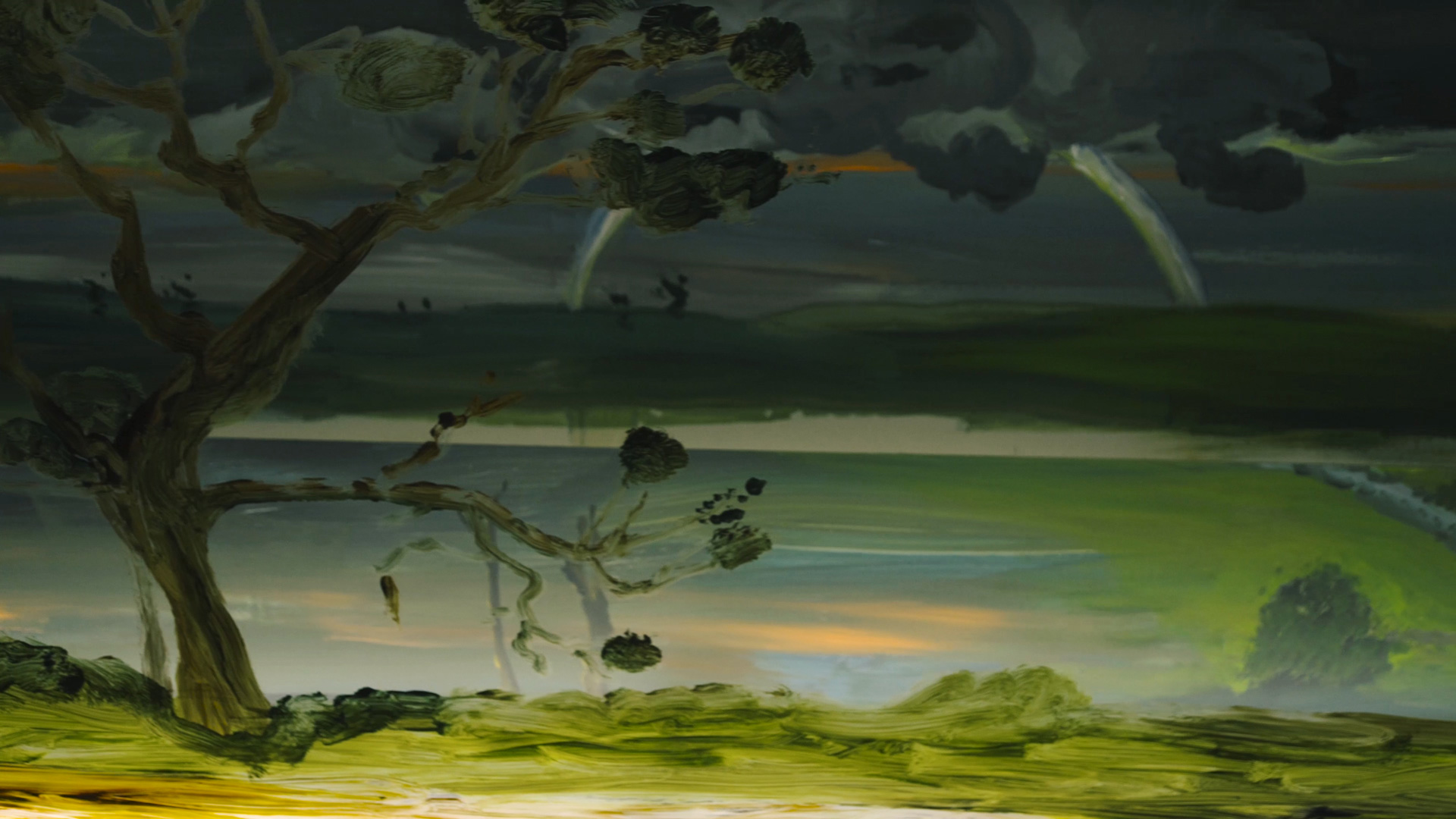
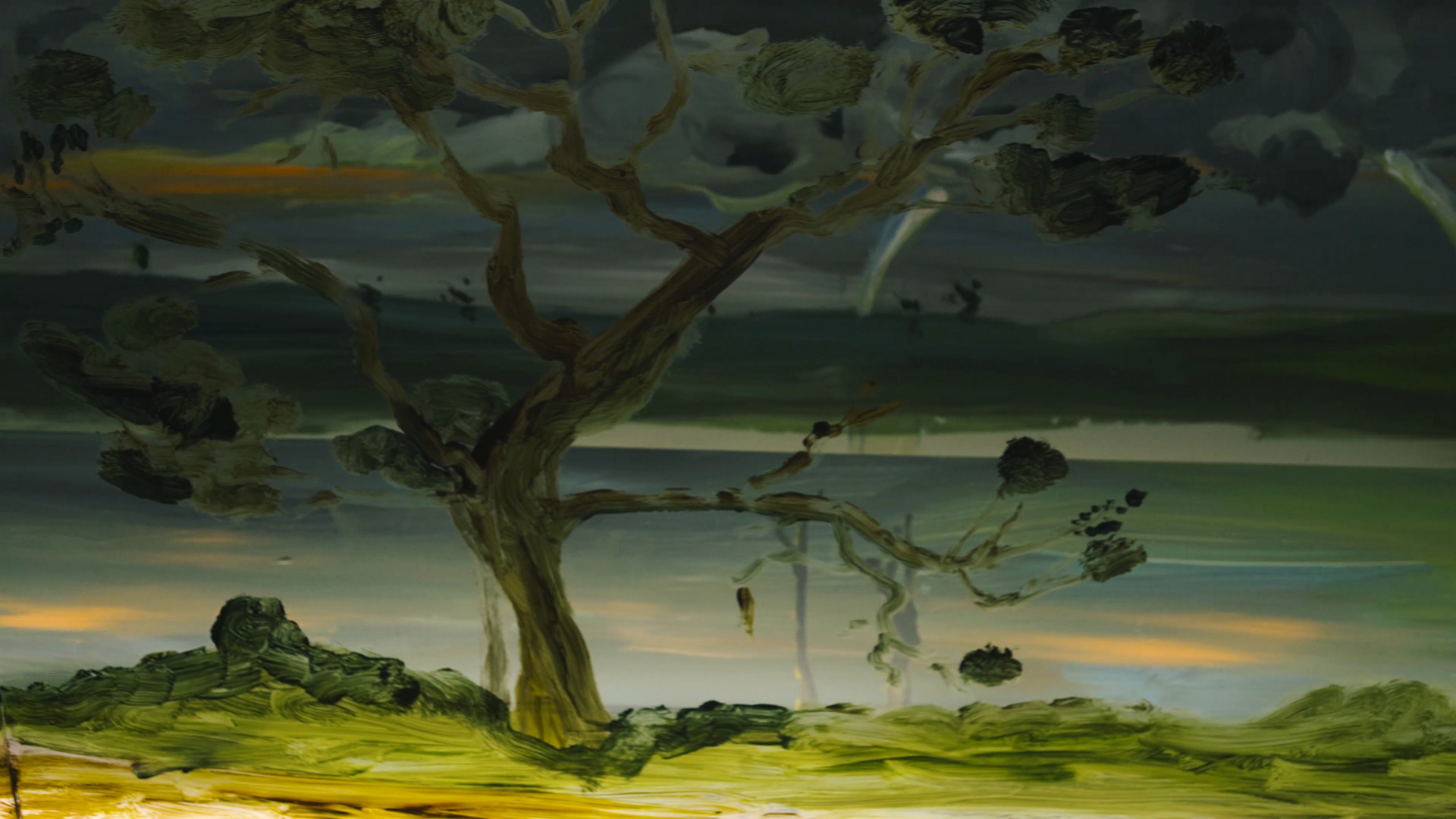
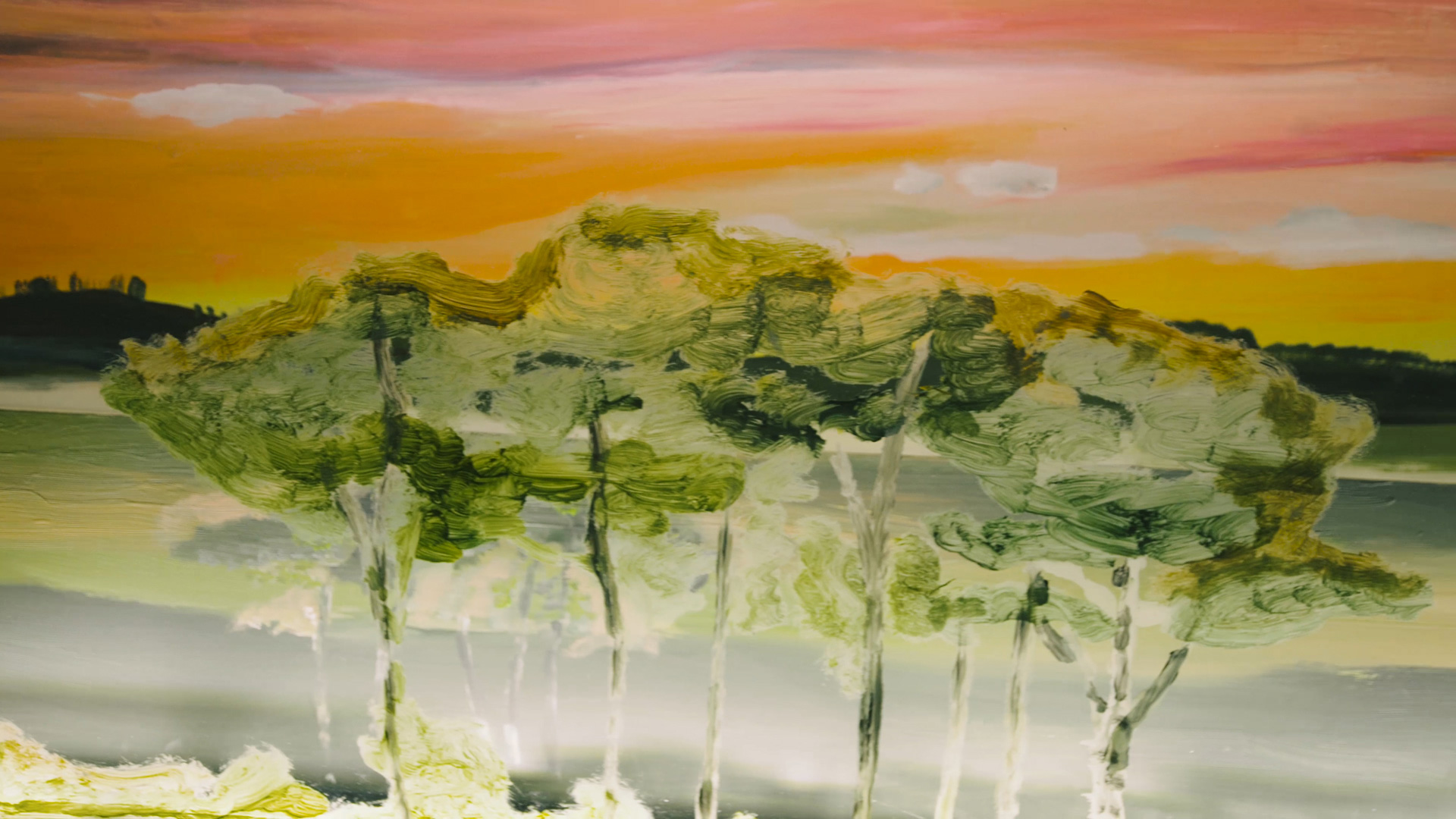
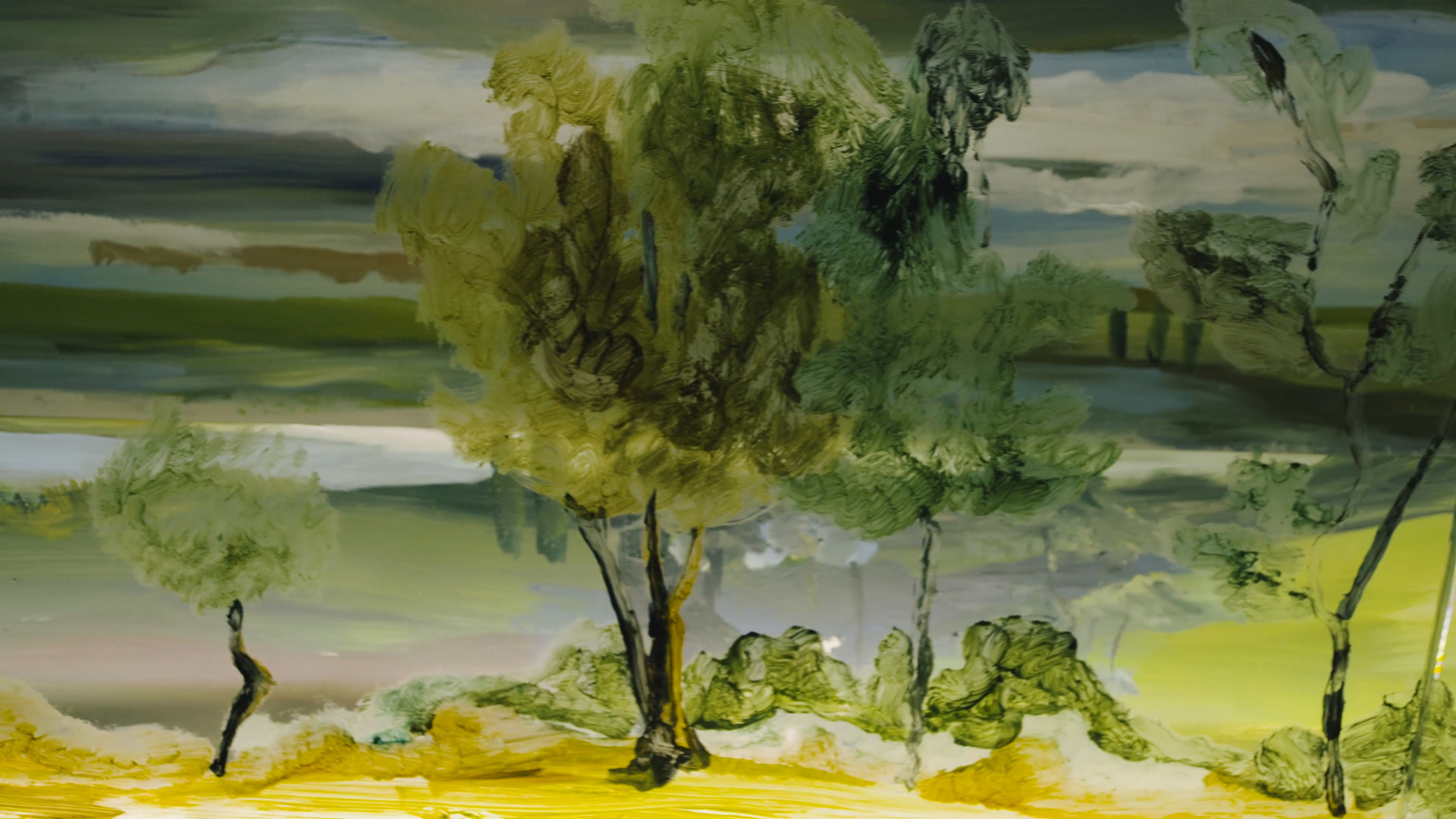
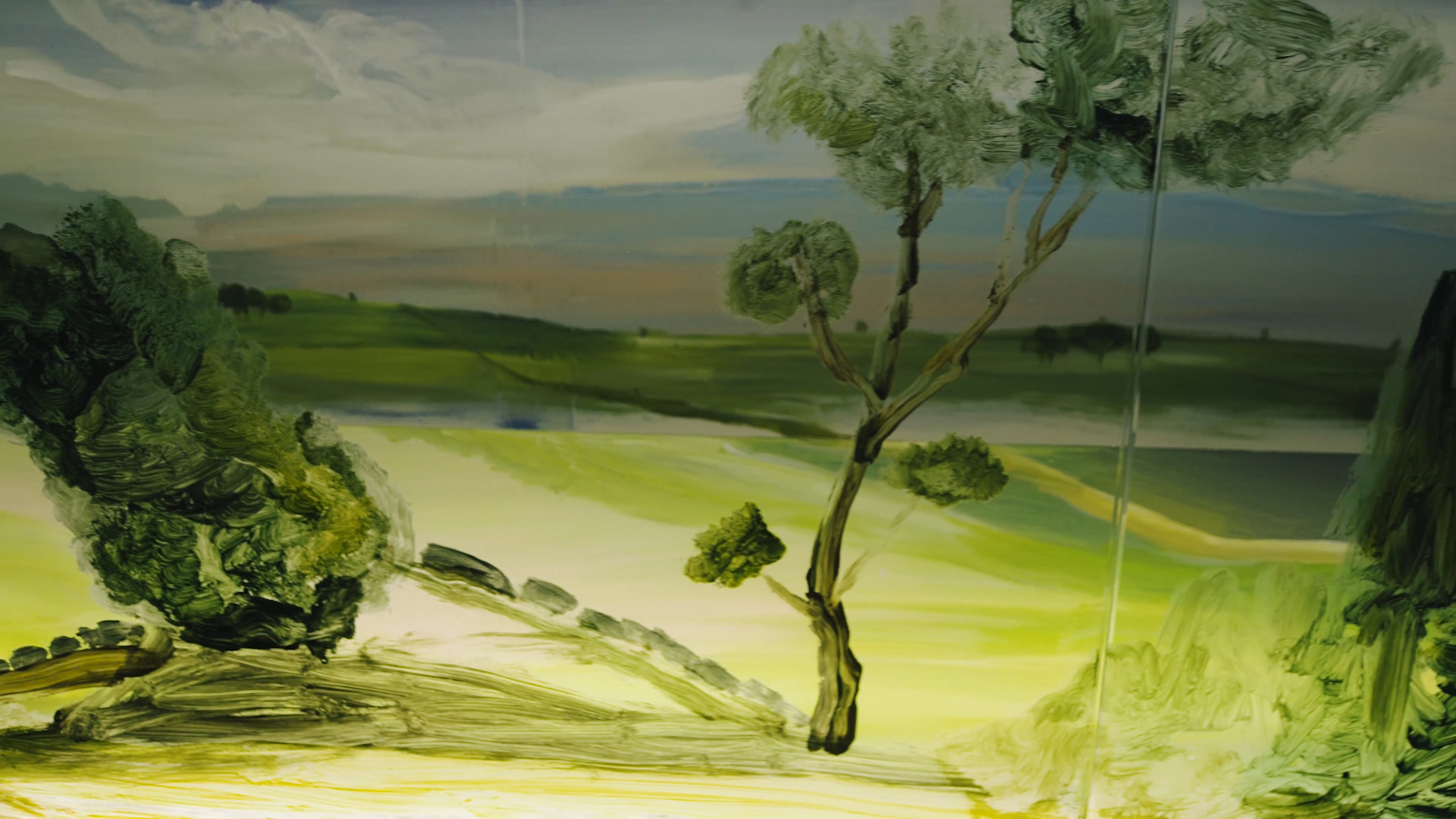
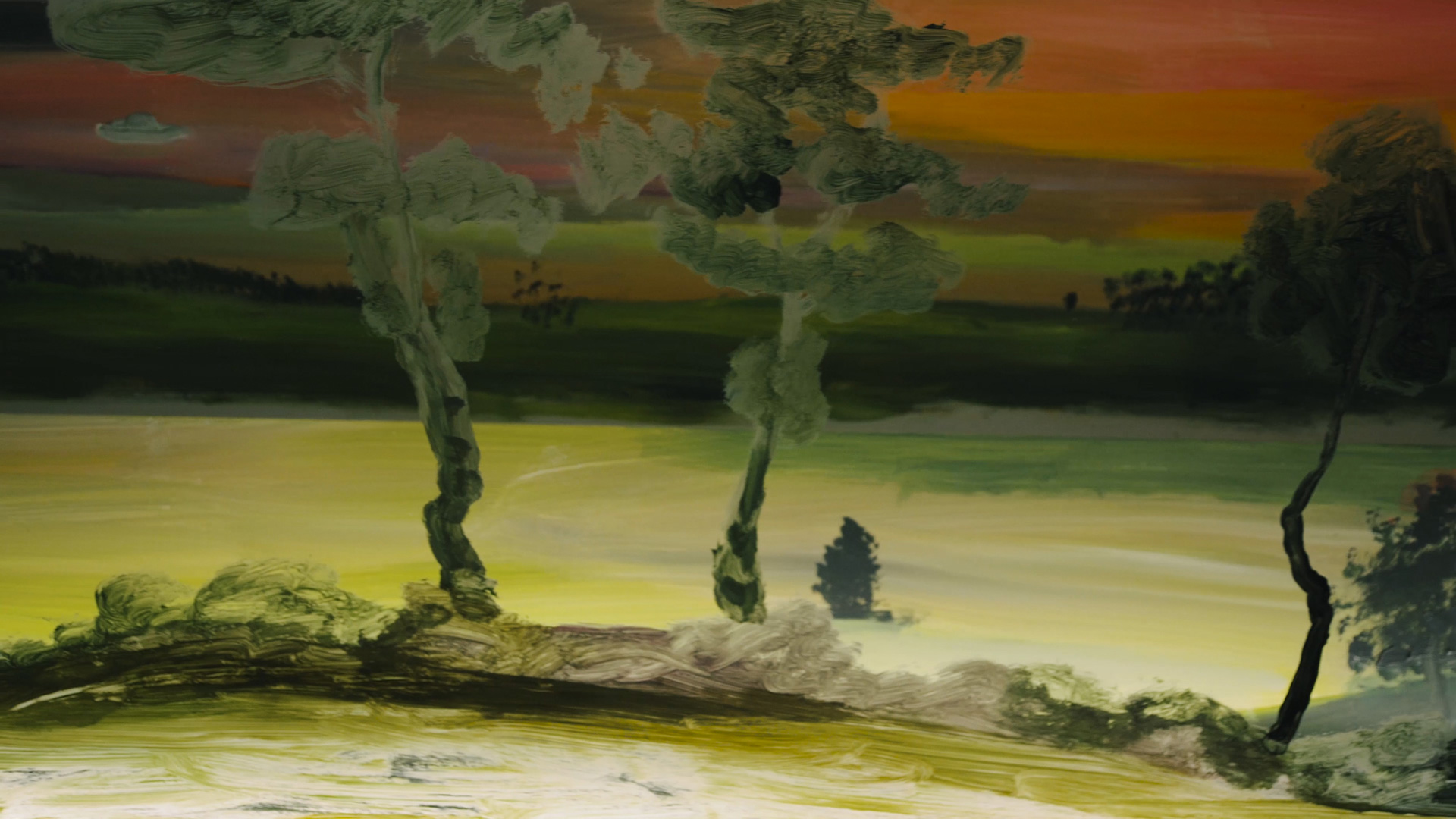
Just take a film like ‘Ein langer Tag’ (A Long Day, 2018) from the Julius Baer Art Collection. The film features a long stroll through an idealised pastoral landscape. It is poetic and airy, simple but utterly mesmerising. However, the film is not only technically an animated painting, for which Erb slowly moved the camera along a multi-level painting on glass (hence the different layers). It also clearly engages with the history of landscape painting, and its ability to imitate depth and create an atmosphere. The titular long day may even be read as a hint towards the long and enduring life of the medium of painting itself.
Extending the Canvas
‘Ein langer Tag’ is currently on view in Erb’s exhibition ‘Curtain falls dog calls’ at Aargauer
Kunsthaus, her largest institutional solo show to date. Indeed, the show is ‘organised like a film
itself’, as the artist says. ‘Each room is staged differently, almost like on a film set.’ And on these
various sets, we encounter the different sides of Erb’s multifaceted practice, one that may centre on
painting and its techniques, histories and sensibilities, but also extends far beyond the canvas.
Painting here is placed within a setting and put on a stage – as an exemplary model of thinking in,
through and about images.
Sometimes, the expansion of painting happens quite literally. The series ‘venusinfurs’ from 2022/23, one of Erb’s most enticing and beguiling series in recent years, is a case in point here. The colourful imagery on these large-scale canvases is centred around bare female legs, often partly covered by features like fur, hair or cloth. Every so often, these legs seem to be painted from a peculiar first-person perspective down one’s own body, turning the sensual motif into a feminist statement: women are not only pictured on the canvas (as is typical in art history) but also happen to be the one painting it (less typical). Furthermore, Erb frames these canvases with a border made from frilly, shiny, colourful fabrics. ‘For me, working with fabric permits an extension of painting,’ Erb says. The paintings’ frills add a material element and literally unfurl and extend the pictorial space of the canvas into the room.
Ghosts from the Past
Erb’s handling of painting was not always as playful and free as it is today. Indeed, her relationship
with the medium is long and complicated, marked by various phases of distancing and re-approaching (in
fact, a bit like the constant movements back and forth that a painter might act out in front of a canvas
in the performative process of creating it). In the early 1990s, shortly after she finished her studies
at Zurich Art Academy, the artist decided to destroy all her work to date – mostly paintings. She simply
felt unable to contribute anything new to the age-old and highly traditional medium.
Following this cathartic act, she ventured into installations using a much more restrained and rigid formal vocabulary derived from 1960s/1970s minimal and conceptual art. During these years, Erb turned to interior elements such as room dividers and paravents as well as to fabrics, sometimes printed with stripes, grids or even ornamental flowers. Other than painting itself, this kind of vocabulary traditionally tends to be located within arts and crafts or the domestic sphere – that is, with areas much more closely associated with ‘women’s work’.
Around the mid-2000s, however, Erb picked up a brush and paint again. She decided to give traditional forms of painting another try. Although the focus on fabrics and interiors remained in some of the works from that period, now she often painted them in a more classical style. The Julius Baer Art Collection holds some pieces from this phase, such as an untitled canvas from 2007 and ‘Das Kleid’ from the same year.
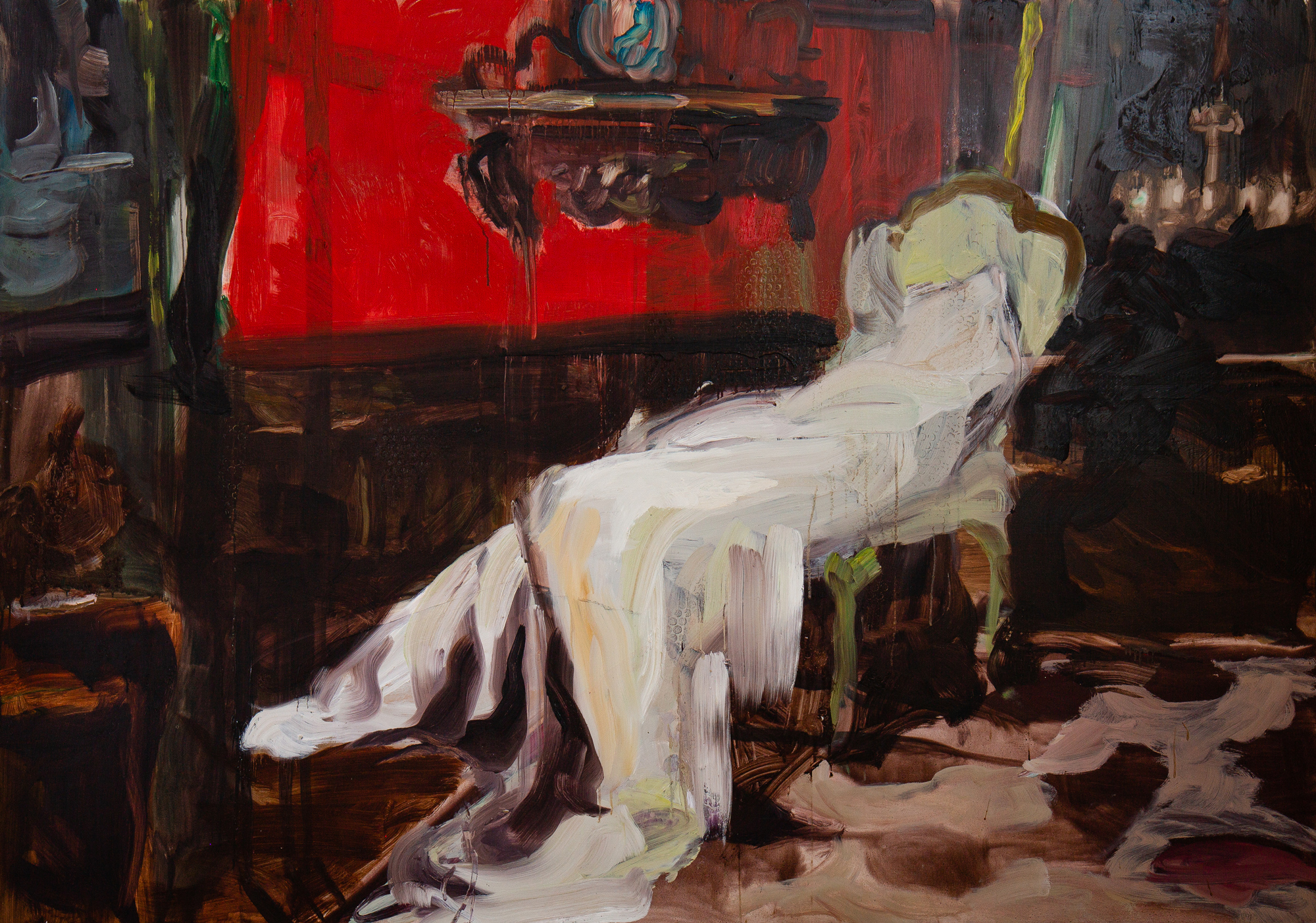

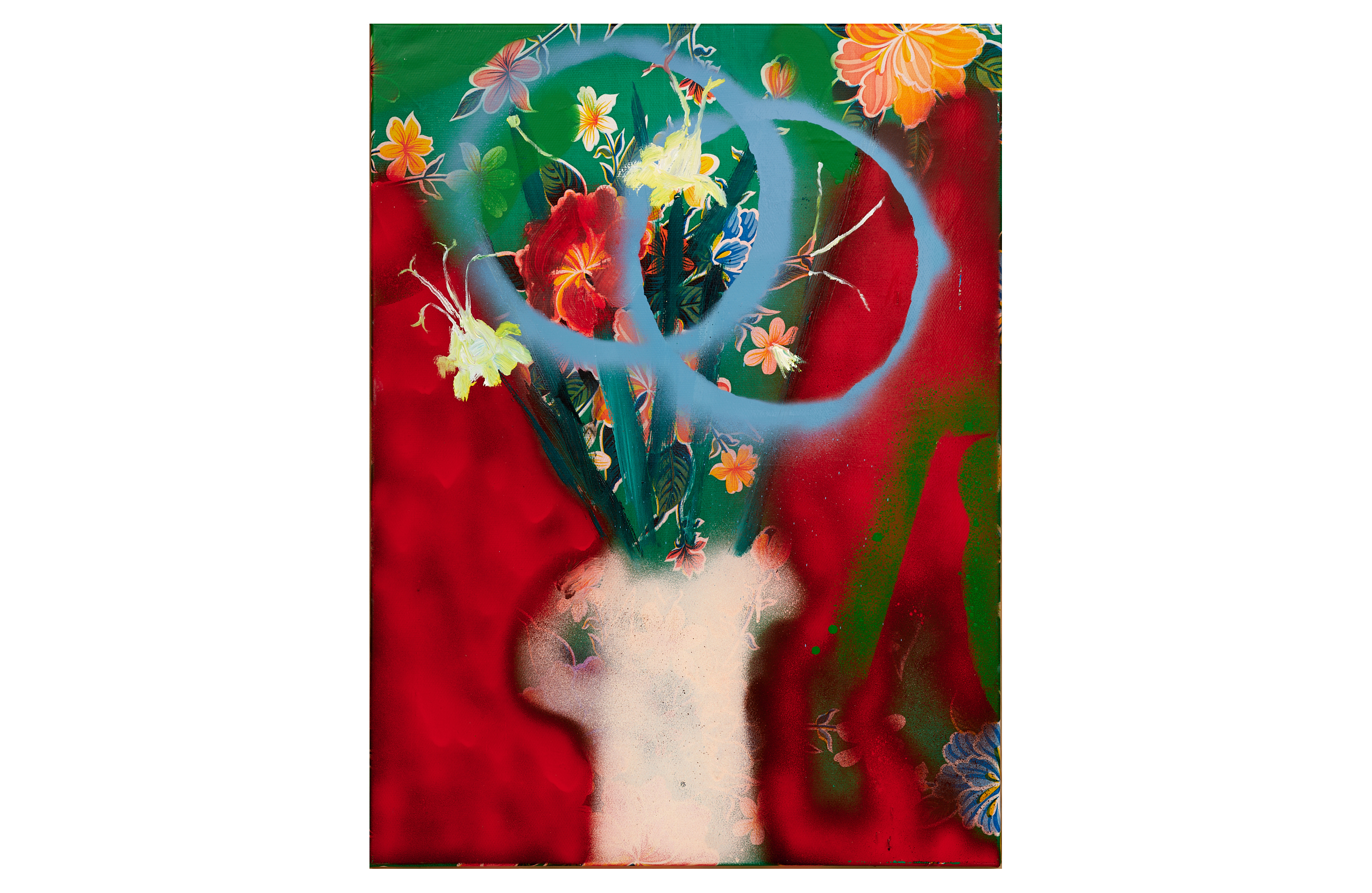
Both works feature dark and somewhat classical bourgeois interiors. The first shows a reclining and eerily headless silhouette at its centre, draped in a posture reminiscent of countless historical depictions of women; the other is a figure sitting in a bulky and undulating whitish dress, also missing its head. Far from just showing ghostly figures, these works are a bit like ghosts themselves – remainders (and reminders) of an age-old artistic practice named painting that was already said to be dead and buried, only to rise again from the grave and make an astonishing comeback.
Under One Sky
Today, Erb’s work, mostly organised in series on a specific theme, seems steeped in history and
conscious of painting’s various traditions. Yet it feels incredibly lively, open, even funny and jokey
at times. ‘Compared to the 1990s, my relationship with painting is enormously free these days,’ Erb
says. ‘I have long learned to accept my own painterly vocabulary and let loose.’ A brief look at some of
her work from the last 10 to 15 years reveals an astonishing breadth and scope when it comes to visual
repertoire, techniques and the various movements in, out and around the medium of painting itself.
Erb’s imagery includes serial remakes of a famous Rembrandt self-portrait – sometimes almost comically funny with long and pointy noses or an added cigarette, at other times almost dissolving the face in pointillistic swabs or thick brushstrokes (‘REM’, 2012). It encompasses poetical and sparse experiments with running blueish and mauve-coloured ink on canvas (‘Transformation’, 2016/17) as well as semi-abstract paintings using a type of paint known as afterglow (e.g. ‘Die Parade’, The parade, 2021, from the Julius Baer Art Collection). There are repeated takes on the visual language of emojis; or a film and a whole complex of accompanying paintings organised around the motif of the lemon – as much an element of classical still-life painting as a comical stand-in and alter ego for the artist herself (‘The Sweet Lemon Ballad’, 2016).
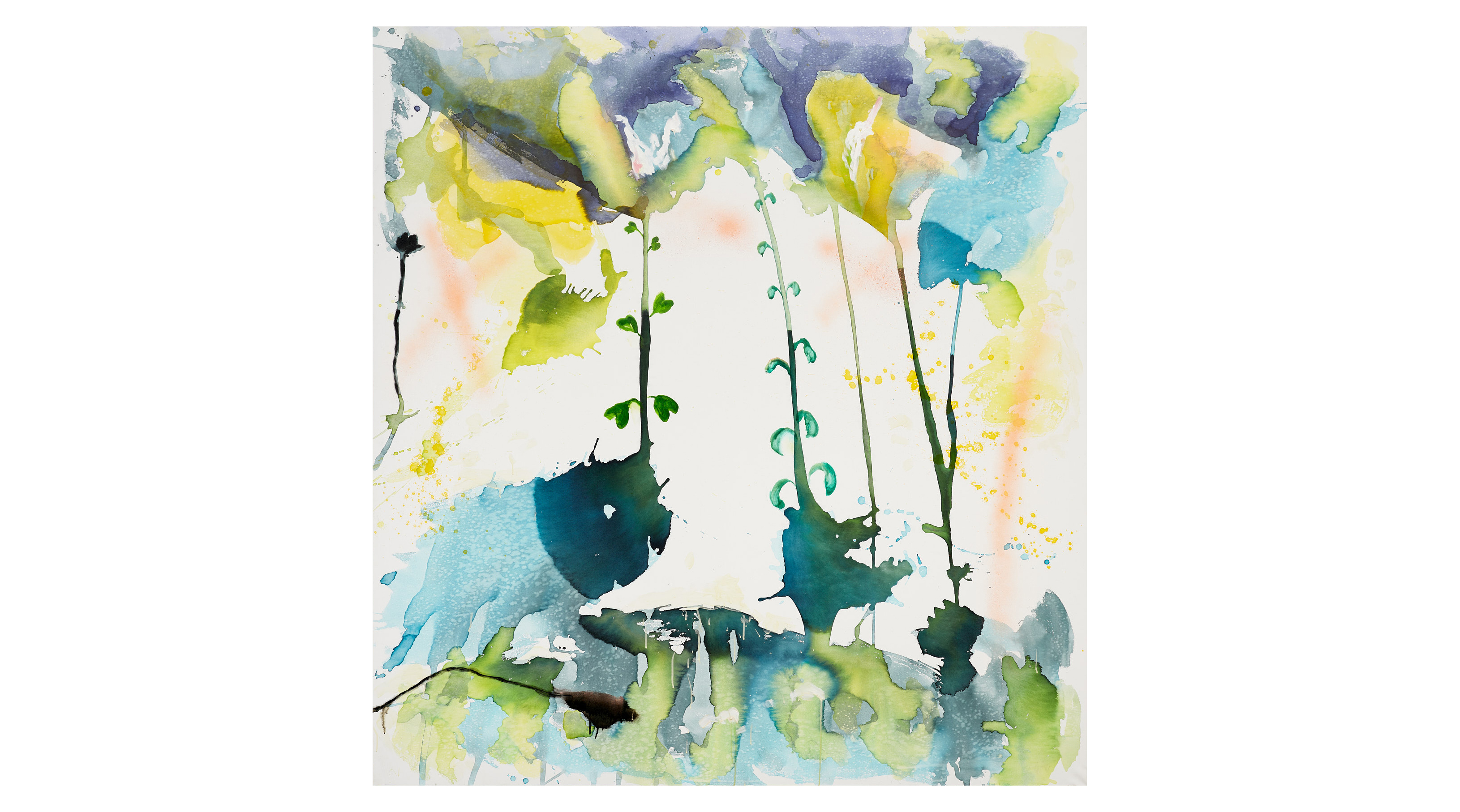 Klodin Erb (b. 1963), ‘Die Parade’, 2021, ink, pigments (phosphorescent paint), oil and acrylic spray paint on canvas, 170 x 160 cm, courtesy the artist and Julius Baer Art Collection
In general, Erb’s take on painting is a decidedly feminist one. Aside from her frequent use of fabrics and materials traditionally associated with women’s work, she also addresses the question of female representation. A particularly striking example is ‘Alle wissen es’ (Everybody knows, 2012), a series of dark and brownish paintings in acrylic, oil and asphalt varnish showing women reading in dim light in various stages of figuration or abstraction. ‘For a long time women were not allowed to read,’ Erb says, ‘and instead they had to do embroidery or similar tasks all the time.’ The series is currently on view in ‘Toutes le savent, même les anges’, a second solo show by Erb at the Musée des Beaux-Arts in Le Locle. Also exhibited there is her newest body of work, ‘Planetarium’, 2025, a set of massive freestanding canvases depicting mythological star signs and creatures. Erb decided to show three canvases from the series in Le Locle and three in Aarau to connect both shows. ‘They are metaphorically reaching over the whole sky from one museum to the other.’
An Invention of Self
A specific place in her vast oeuvre, though, is reserved for themes and motifs to do with metamorphosis,
and things merging and melting into each other. There are dancing beetroots and other vegetables,
connecting, blending in dynamic and swirling movements almost to the point of forming a new collective
body (‘Kräfte und Säfte’, powers and juices, 2021); there are ‘Mermaids’, 2023, some of them female,
others male, some fish, some dissolving into abstraction; there is the ancient myth of ‘Leda und der
Schwan’ (Leda and the swan, 2024) as told by Ovid in his famous magnum opus ‘Metamorphoses’; and then
there is ‘Orlando’, 2013–21, one of the artist’s most impressive and long-running series encompassing
almost 200 works.
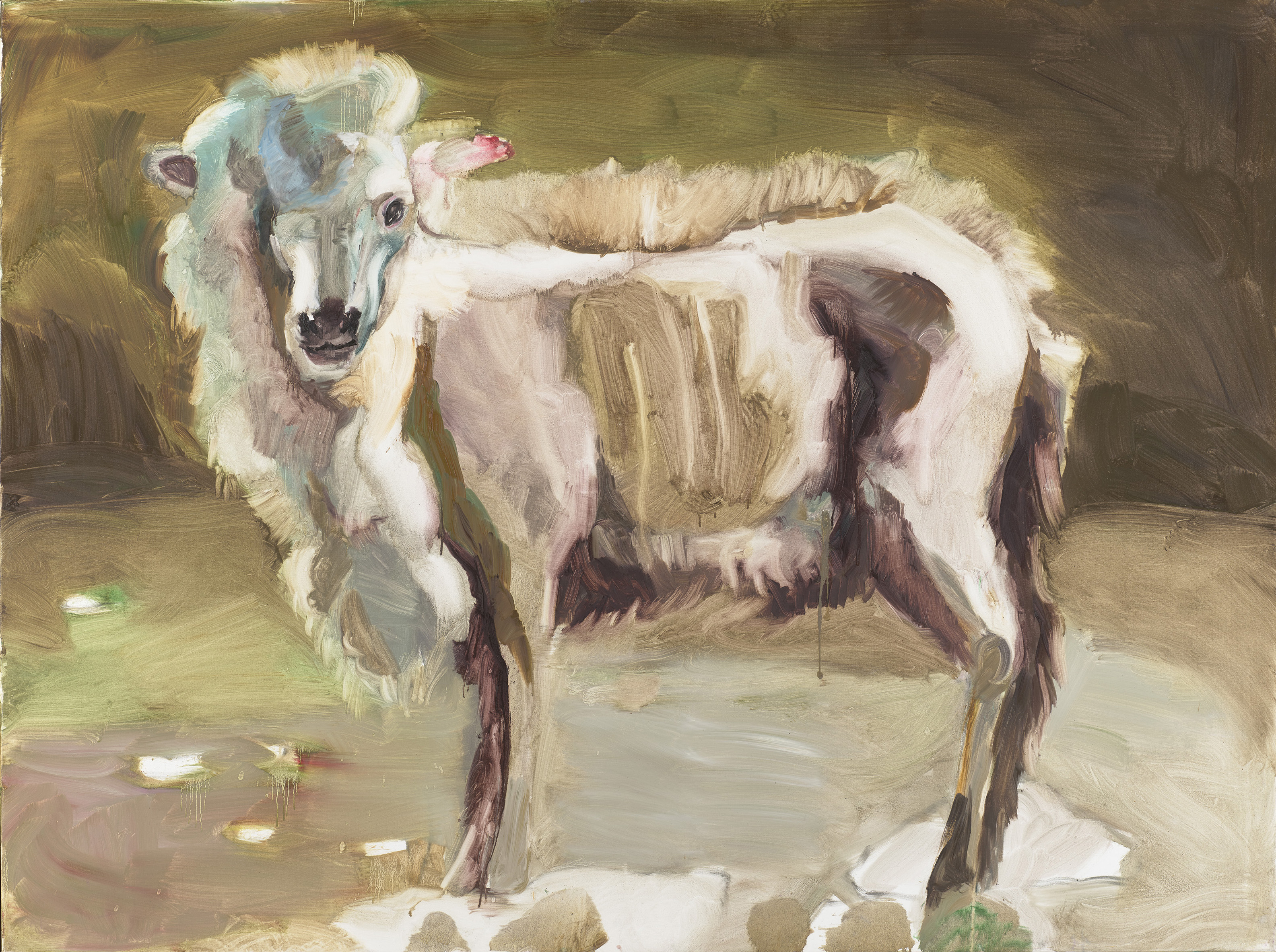
The series takes its inspiration from Virginia Woolf’s eponymous 1928 novel, whose protagonist mysteriously lives through the centuries and, at one point, even changes sex. Aside from the gender component, the story is, Erb says, ‘also one of travelling souls’. Her series assembles countless portraits: pop-culture characters like Daisy Duck or an alien from James Cameron’s 2009 film ‘Avatar’, comically cubistic heads, cats, sheep, children, robots, dogs, takes on highly esteemed art-history motifs and many more. ‘Everything is connected with everything,’ is how the artist sums up the thinking behind the series, ‘and I strongly believe that we are, in large parts, composed of our connections with our ancestors, with society, with history, with nature. These connections are what I am ultimately interested in,’ she adds. ‘And not that thing we call “the self”.’
In that regard, painting can be a unique space for freedom; a way of approaching the world, of taking things and cutting them out, so to speak, by picturing them on a canvas, only to connect them anew time and again. It is a practice that is as rigid and analytical as it is intuitive and playful. ‘Painting’, Erb says, ‘is always an invention of the self. It is a medium that is incredibly easy and accessible, and it allows you to do things quickly – and redo them again.’ When seen that way, painting, with all its baggage and complex history but also its simplicity and rudimentary set-up, is a uniquely effective tool. Not only for making sense of our world, but for imagining new ones, too.
Author: Dominikus Müller
Don’t miss the exhibitions ‘Klodin Erb. Vorhang fällt Hund bellt’ at Aargauer Kunsthaus, Aarau, until 4 January 2026, and ‘Klodin Erb’ at Musée des Beaux-Arts Le Locle – MBAL, until 1 March 2026.