Landscapes of Relationality
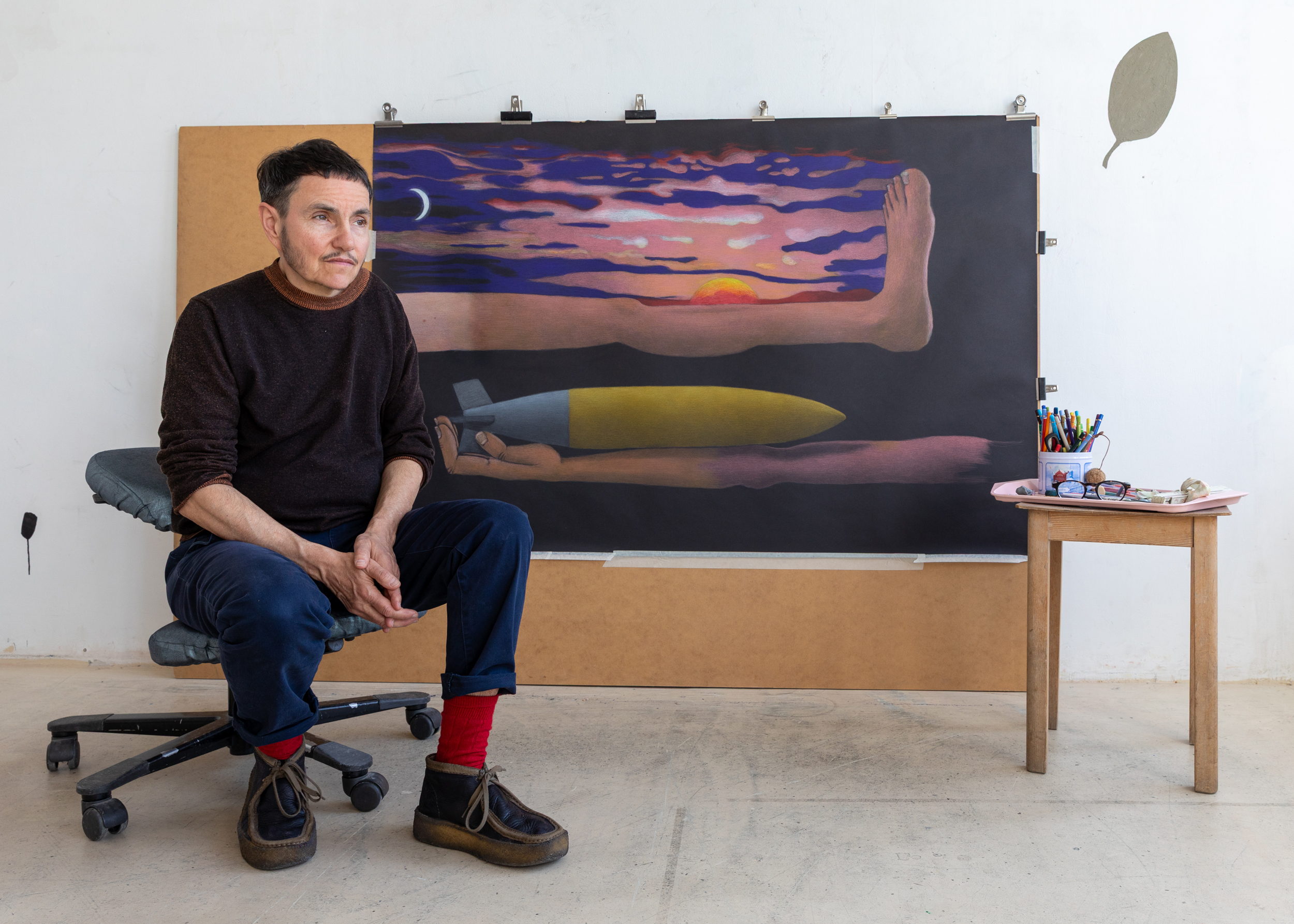 Portrait of Sabian Baumann in their Zurich studio, photo: Paula Tyliszczak
Sabian Baumann’s inventive art-making practice highlights fluidity and porosity while also remaining attentive to difference. Their collaborative art-activist projects, by contrast, engage with questions of gender and intersectionality on an explicitly political and educational level. This summer, a selection of Baumann’s drawings and sculptures is on view at the Venice Biennale.
A human skeleton lies buried in the ground. Above it, a somewhat hirsute sun is setting in a vast pastel-coloured evening sky, while the moon is already high up in the heavens. But that’s not all. Assorted human bodies are drawn in the thin air as delicate white outlines. At times intertwined like a puzzle, they seem to be holding onto or even moulded around each other: stabilising, mirroring, interlocking. Feet in heavy shoes or loose-fitting socks enter from the edges, as does a hand in a cartoon-style glove. A set of teeth rests on a person’s back. While one figure wears a clown mask, others are endowed with delicately rendered animal heads.
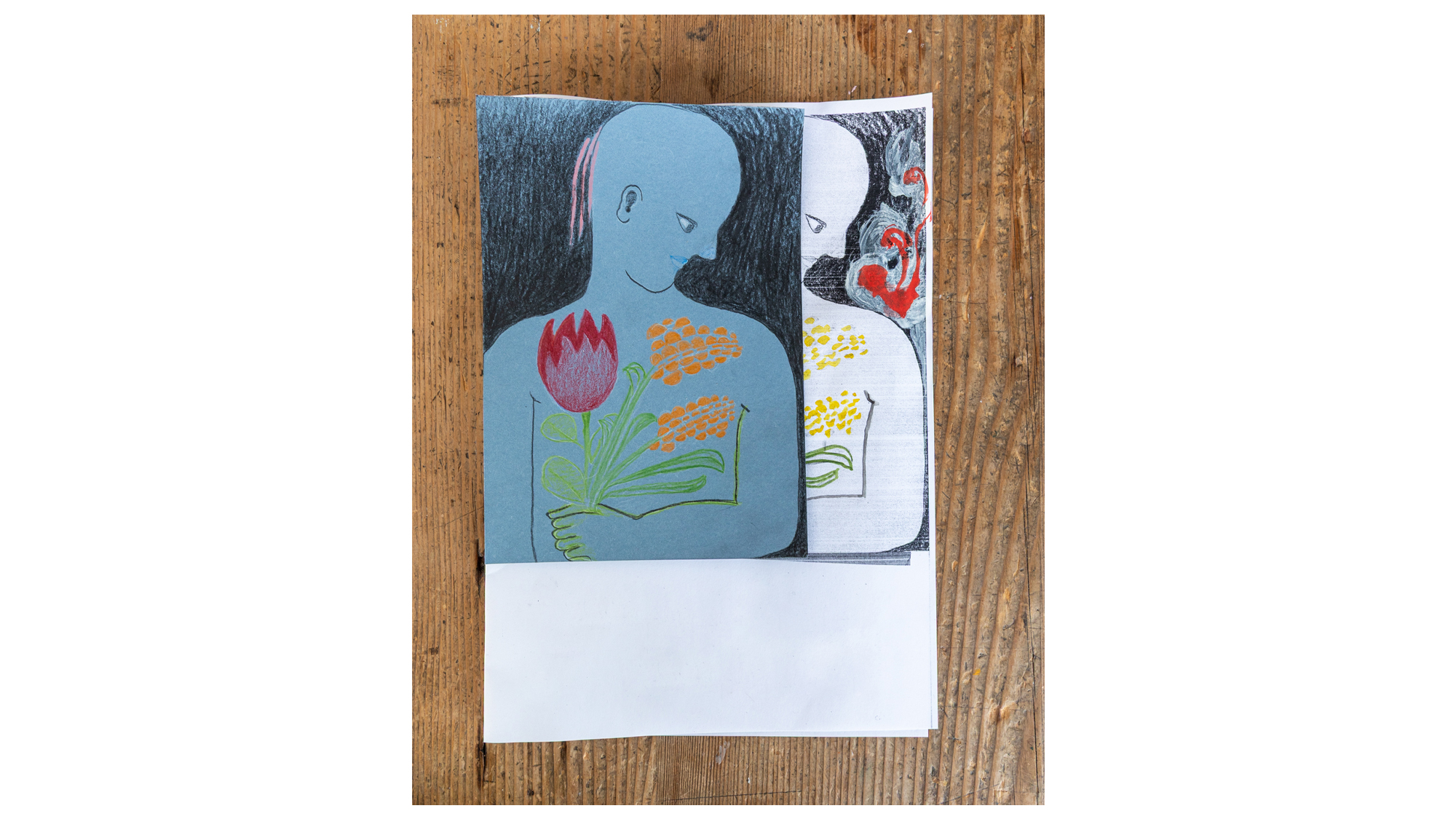
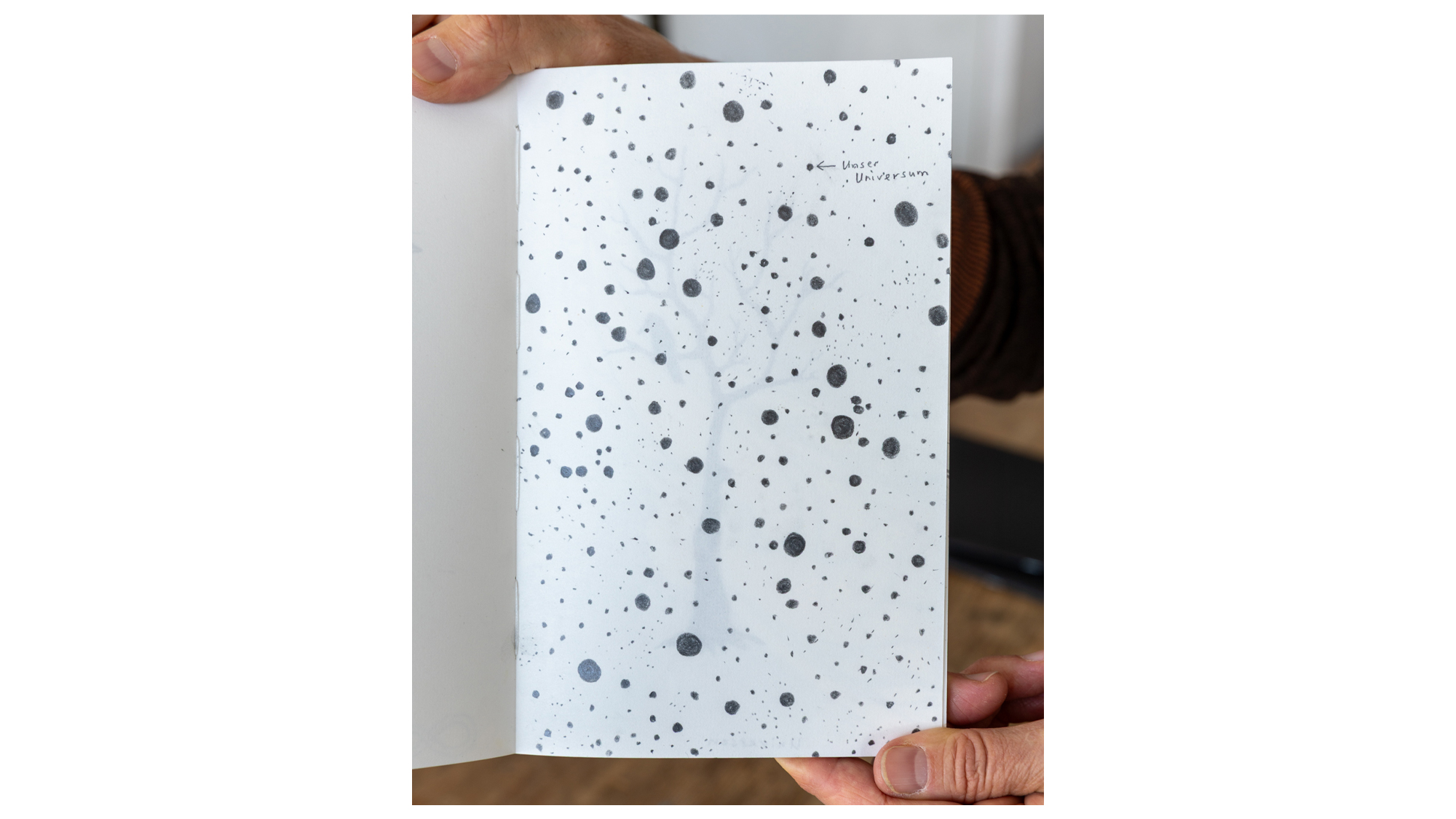
‘Performing Earth’ (2020) is characteristic of Sabian Baumann’s recent drawings, a selection of which are on view at the Venice Biennale’s main exhibition ‘In Minor Keys’. Although conveying a rather surreal if not enchanted feel, the work also reveals evidence of a clear sense of humour. Above all, however, it articulates the approach that defines so many of Baumann’s drawings: multi-species and ecological, decidedly non-hierarchical and fluid. Drawing, as an accessible, cheap, somewhat provisional and ever-changing medium pursued by the artist since the late 1980s, ultimately becomes a dedicated tool for world-building.
CONNECTIONS AND DIFFERENCES
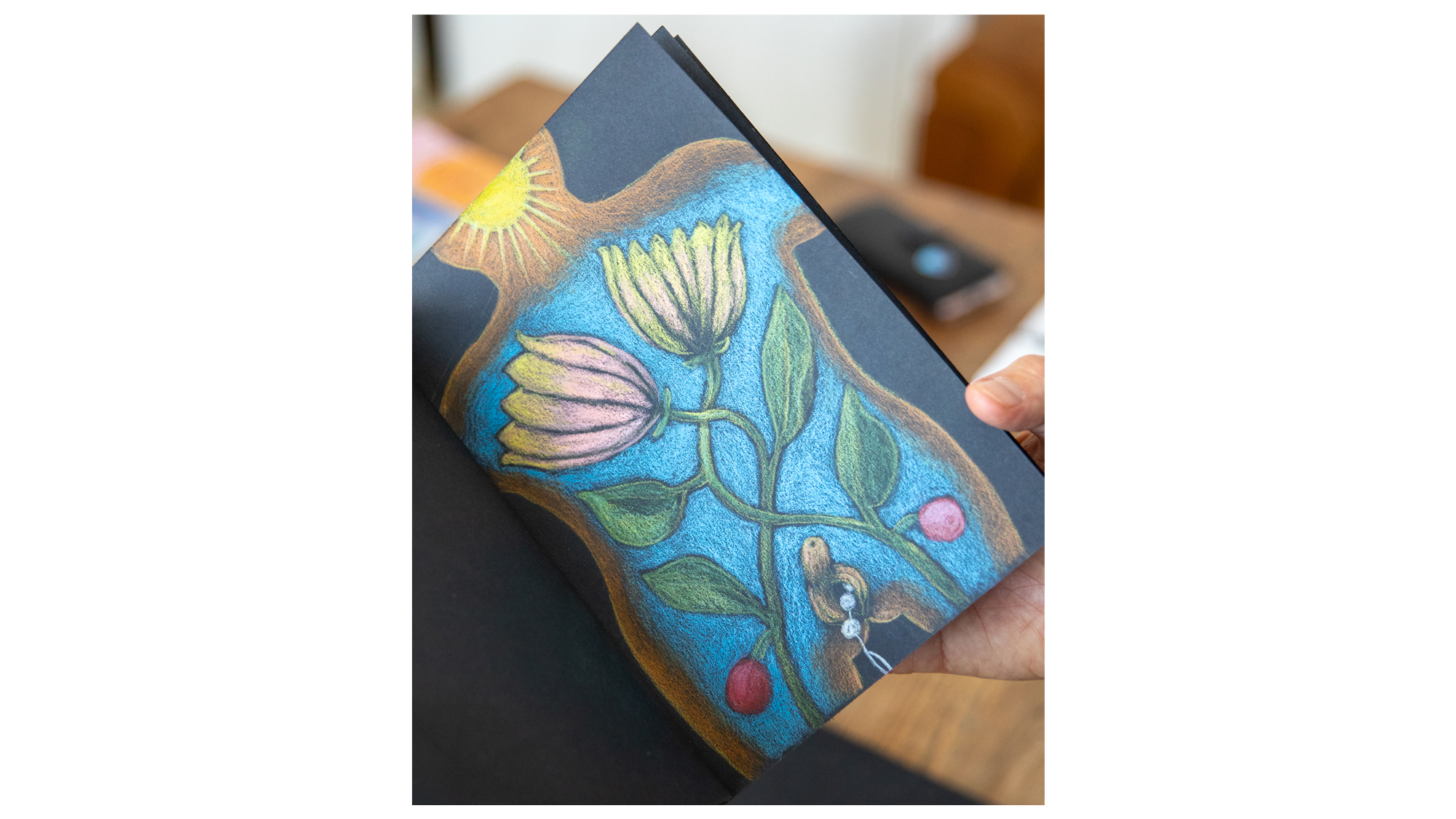
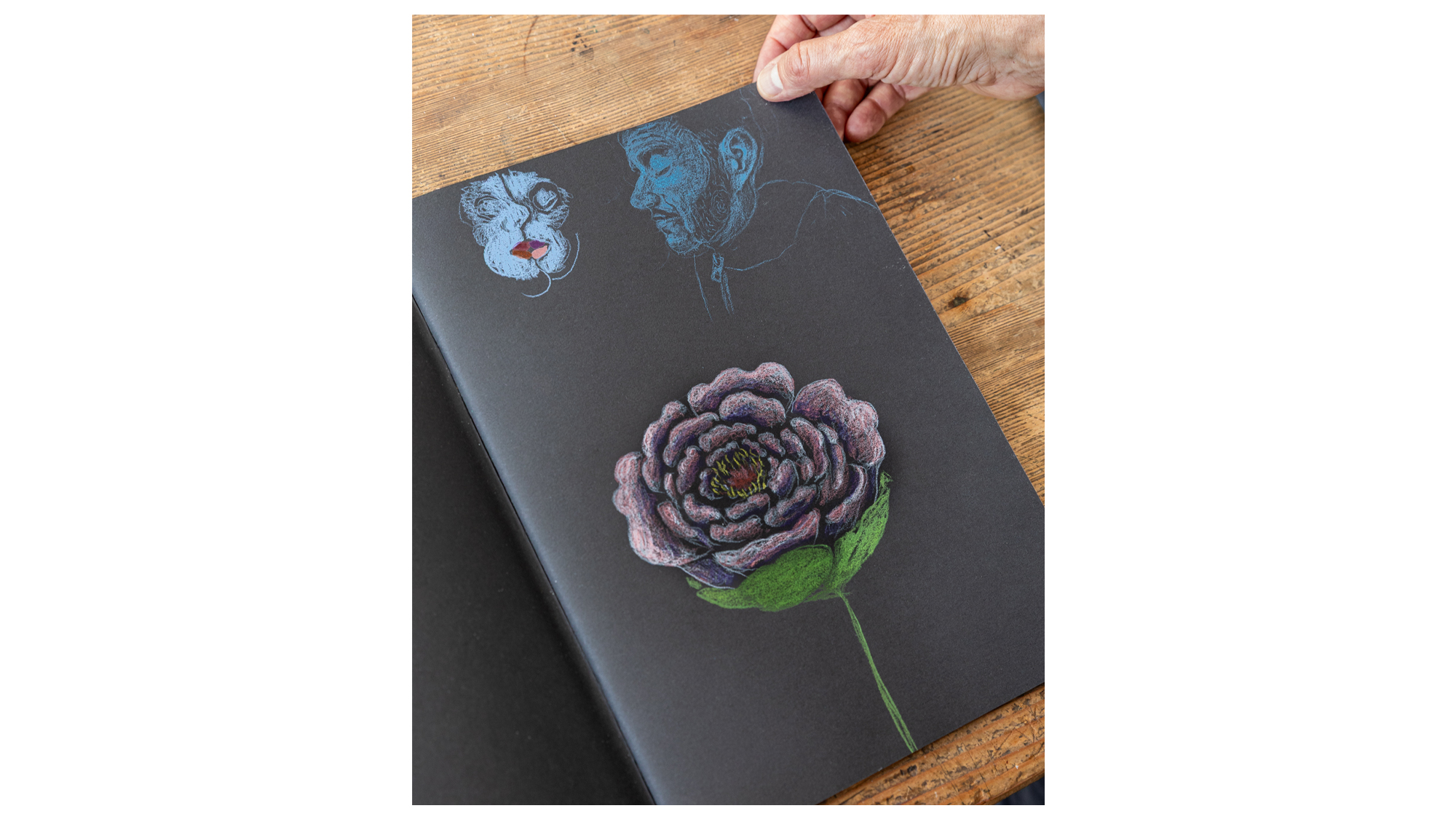
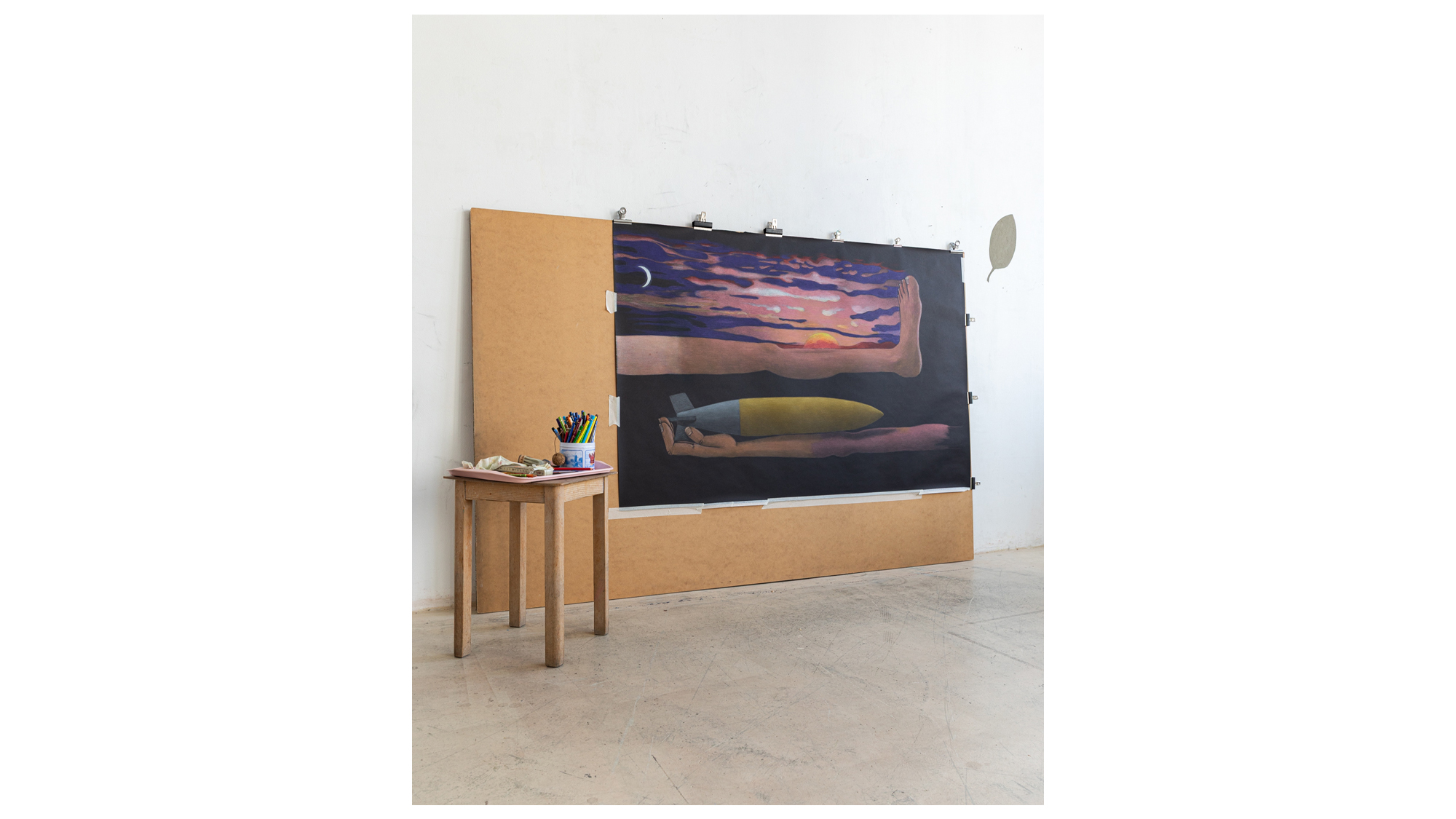
In many of these recent works, which have been predominantly executed with colour pencils on black
paper, Baumann sketches out the relationality between creatures, plants and other earthly things, as
well as the connection to the universe in general. One thing can become another, and then something else
again. ‘I want to show that everything is interconnected with everything,’ is how the artist describes
the motivation behind the works to me. ‘Everything is there at once; it’s day and night at the same
time, and we are above the earth as we are below it.’
So we find that flowers double as eyes in ‘Nature (presque) mort’ (2025), and leaves turn into faces in ‘Du, ich wir, das Leben’ (You, Me We, Life, 2025) and ‘Sonnenblatt’ (Sun Leaf, 2024). Then there are works like ‘Politics in Fairytales’ (2022) and ‘Raupen’ (Caterpillars, 2024, from the Julius Baer Art Collection), which feature hybrid creatures such as a dog with a fishtail – the artist calls this being a ‘dog-mermaid’ – or a flamboyant bird with the body of a dog. In ‘Kuss’ (Kiss, 2024), the other work from the Julius Baer Art Collection included in this year’s Venice Biennale selection, two heads meet in an intimate kiss. Once again, the eyes are composed of plants and the hair is made of leaves. Expansive horizons open up within the contour lines of both heads: here we have the blue sky, there is the sea. This is less a portrait of self-contained individuals seeking the proverbial ‘essence of things’ than a landscape of relationality, where certain elements appear alongside others, all of which are connected and embedded, always shifting and co-existent.
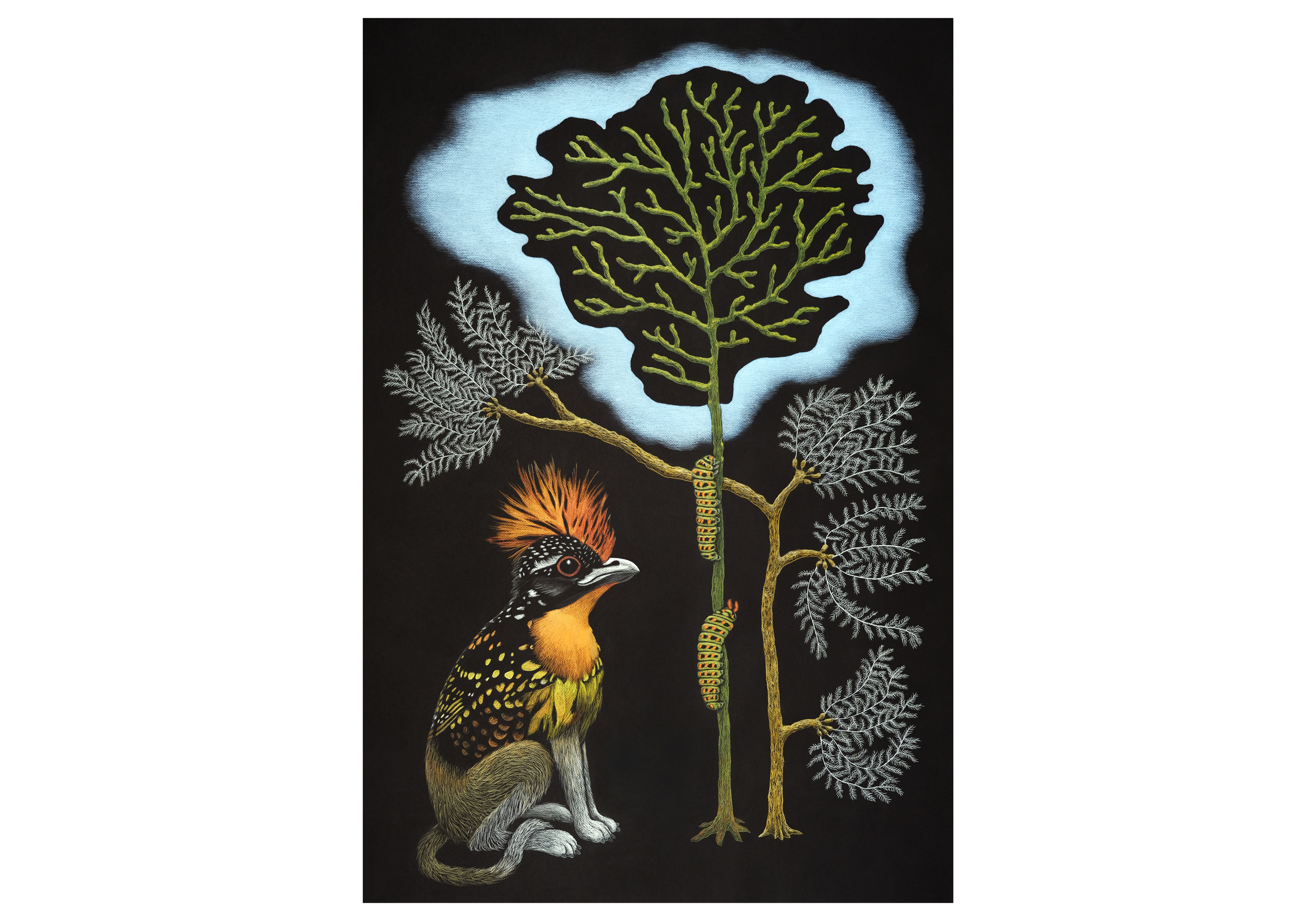 Sabian Baumann (b. 1962), ‘Raupen’ (2024), coloured pencil on paper,
139 x 94 cm, courtesy the artist and Julius Baer Art Collection
Sabian Baumann (b. 1962), ‘Raupen’ (2024), coloured pencil on paper,
139 x 94 cm, courtesy the artist and Julius Baer Art Collection
Yet interconnectedness, even to the extent of things merging together, does not collapse into an overarching ‘oneness’. A move of that kind would reduce difference to a normalising sameness once more, closed off and identical to itself. ‘Normality’, Baumann writes in the introduction to their 2025 publication ‘sabian von innen’, ‘is an exception in space and time’. Instead, it is the case that ‘differences between cultures and scenes, languages and mentalities, decades and centuries are obvious. These differences cannot be translated into each other or cancelled out. (In)Dividuals are unique collages.’
We are always more than one, always ‘containers which certain things run through’, as Baumann puts it in our conversation. This also implies that ‘there is no such thing as authenticity’, a conviction that underpins the artist’s collage-like approach to drawing. As the ‘sabian von innen’ statement puts it: ‘In the drawings, quotations from various aesthetics – from art, popular culture, photography and my “own” aesthetics – represent this disparate patchwork that we and the world are.’
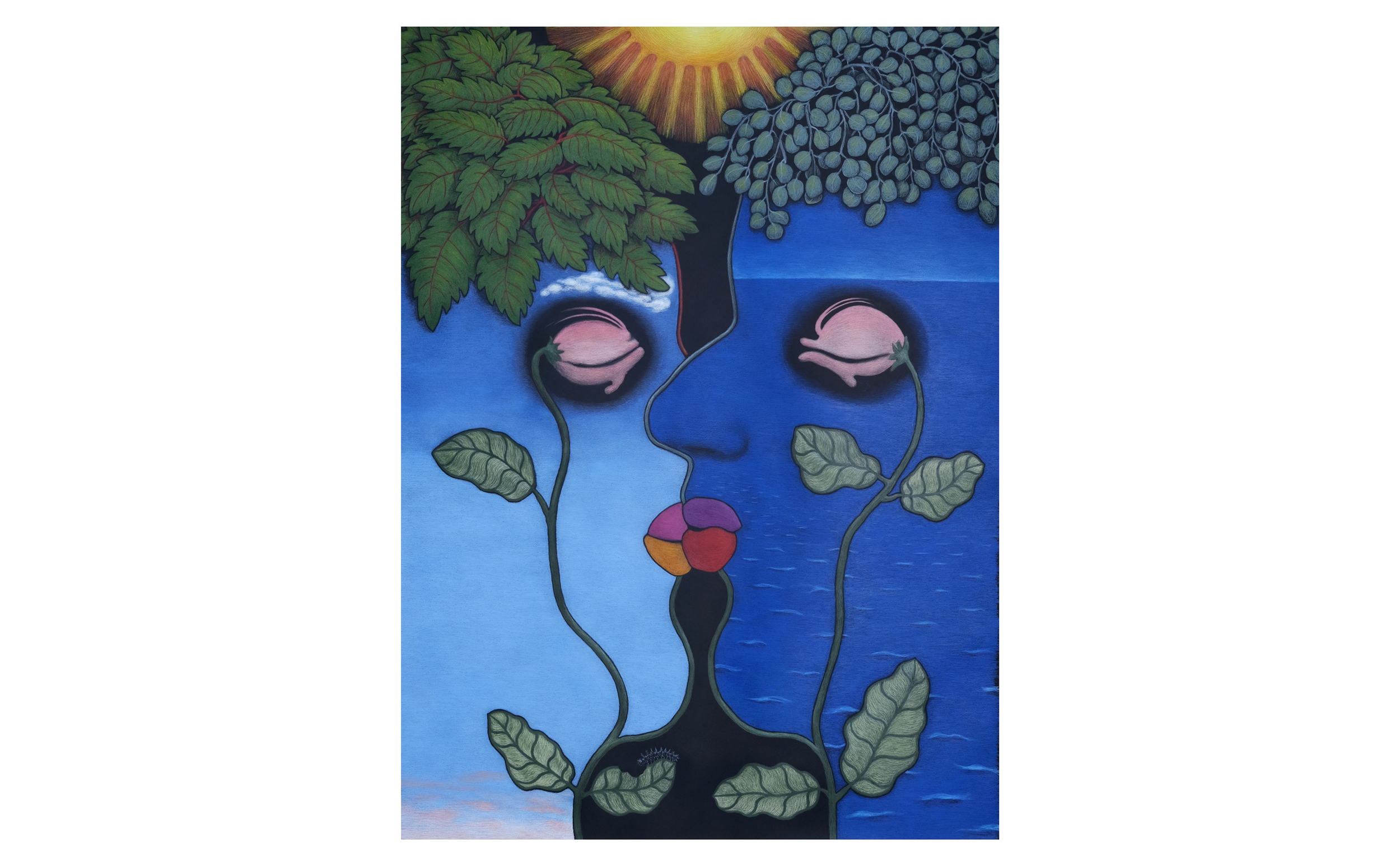 Sabian Baumann (b. 1962), ‘Kuss’ (2024), coloured pencil on paper, 148 x 109 cm,
courtesy the artist and Julius Baer Art Collection
Sabian Baumann (b. 1962), ‘Kuss’ (2024), coloured pencil on paper, 148 x 109 cm,
courtesy the artist and Julius Baer Art Collection
POROSITY AND FISSURES
Alongside selected recent drawings, the main exhibition at this year’s Venice Biennale also features a
series of sculptural wall reliefs created by Baumann in 2013–14. Titled ‘Horizontales Paradies’
(Horizontal Paradise), these small works depict scenes of love that often involve more than two people –
for instance, four bodies stacked together, or two making love while a third lies beneath, on the other
side, reaching upwards.
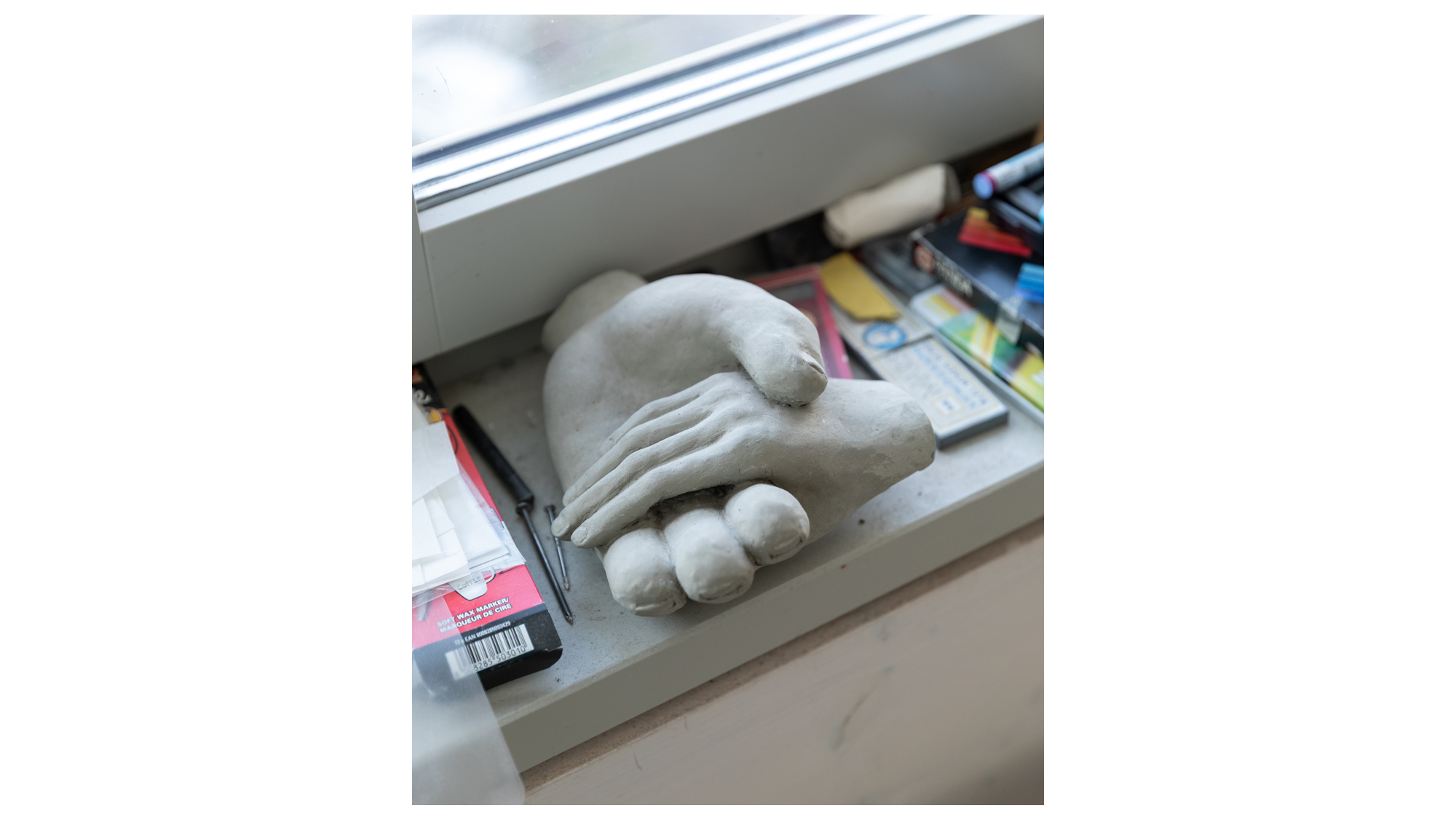
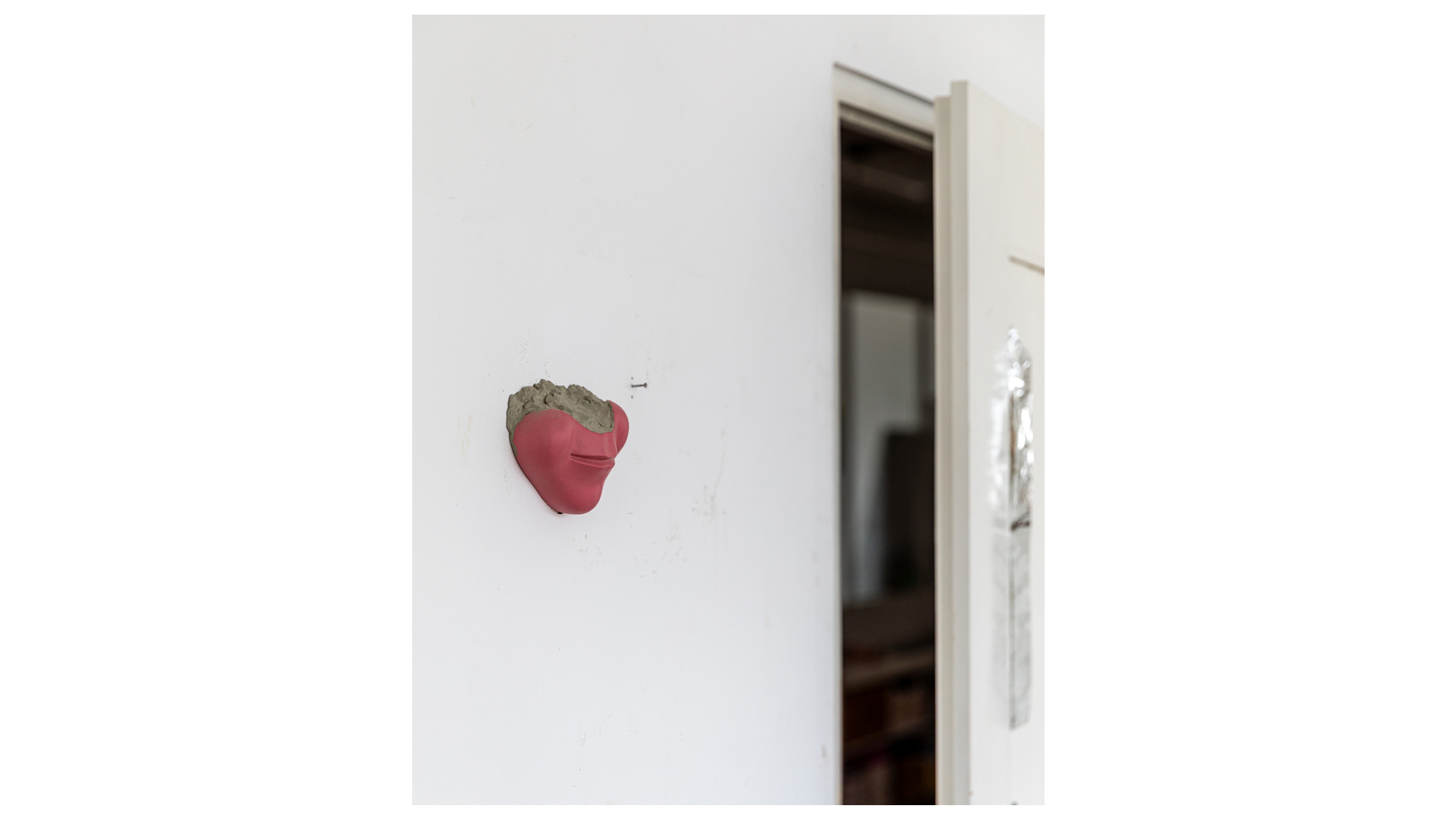
‘I wanted to address non-heteronormative sexuality’, Baumann says about these works. ‘The series presents a whole spectrum of touch, love, sex, but also tenderness and relations.’ Much of the openness and accessibility of these pieces derives from a deliberately modest formal language, as well as from their material itself: unfired clay. Its grey tones and rough texture are direct and yet fragile, introducing a level of abstraction to the pieces.
Other sculptural works, such as ‘Earthboy’ (2004) or ‘Art-Cover’ (2007) to just name two, likewise use unfired clay and foreground the transitory nature of all things earthen. ‘If you put unfired clay into water, it dissolves and falls apart’, the artist adds. In ‘Death of the Cool’ (2008), Baumann used clay to create a Mondrian-like grid on a wall. The surface cracked as it dried, threatening to fall apart – a simple yet striking gesture that literally undoes the rigid structures of Modernism.
Thus, two strategies run throughout Baumann's work: sometimes there is a literal and metaphorical ‘fissuring’, and at other time a kind of ‘melting away’ – both terms used by the art historian Yvonne Volkart in an essay on the artist's practice. These strategies ultimately point to a central tension: the process of imagining new, non-binary and non-heteronormative ways of being which are free from the normalising forces of society still requires working through older inherited forms that are often tainted by a brutal colonial, racist and patriarchal regime.
ART-ACTIVIST PROJECTS
Alongside their artistic practice, Baumann is deeply involved in collaborative, art-activist, political
and educational work. ‘Working cooperatively provides an opportunity for dealing with my political and
social frustration’, they explain. Projects include their first film ‘Working on it’ (2008), which was
co-created with Berlin-based filmmaker and film curator Karin Michalski. Addressing questions of gender,
sexual identity and orientation, the film also presented suggestions for gender-neutral language and
explicitly discussed being more than two genders – all at a time when the word non-binary had not yet
been used in German-speaking discourse and the question of gender-neutral language was still to appear
in mainstream media.
For nearly a decade, Baumann worked on an extensive multi-stage project that started in 2013 when the artist travelled with a friend to Argentina, the first country to pass an innovative gender identity law. This led to long-term research culminating in an activistic and performative demonstration at Zurich’s Helvetiaplatz in 2018 called ‘die grosse um_ordnung’ (the big re_order), as well as the film ‘Who Owns the Sky’ (2022) documenting the whole process. The project follows a distinctly transdisciplinary and intersectional approach, situating the initial questions around gender and race within a broader framework to ask ‘how gender concepts are related to colonialism and why the most progressive law for trans* people did not come from the West’, as Baumann writes in a statement to the film.
While Baumann’s drawings sometimes tend towards the enigmatic, this strand of their work is oriented towards clarity, inclusivity and communication. A project like ‘die grosse um_ordnung’ may, at times, use artistic strategies and modes of expression, and it is also presented within a film and art context, but its orientation is decidedly political, directly addressing the issues at stake and trying to reach as many people as possible. ‘Gender concepts are everybody’s business’, Baumann writes, because ‘every human being and every body is bio-politically normed. It is not only trans* or inter* people who suffer from the common gender stereotypes, they are just the tip of the iceberg of the most discriminated against.’
Although their artistic and activist practices are consciously dissimilar, Baumann understands them as being part of the same spectrum. Here too: the different sides are related and connected, and they exist simultaneously, but that does not make them the same. ‘Whereas in art, everything starts with a certain sensitivity that leads to an expression of an inner state’, they explain, ‘activism stands at the other end: It starts with raising your voice if you feel bad.’ Pointing to the complex relationship between self and society, Baumann adds: ‘I often think of myself as my very own laboratory. The system reveals itself through me.’
Author: Dominikus Müller
Sabian Baumann is invited to the 61st International Art Exhibition of La Biennale di Venezia by Koyo Kouoh.